When innovation makes good policing better
On a warm October night in Southern California, Police Air-8 circled a reported gang fight in Ontario as two suspects fled in a vehicle and two others scattered on foot through the surrounding neighborhood.
The area’s winding, curving roads posed a nightmare for even the most proficient tactical flight officers (TFOs). Unlike a structured grid system, the neighborhood’s layout challenged the aircrew’s ability to provide precise directions and maintain continuous visual tracking of the fleeing suspects.
That night, my TFO toolbelt evolved with the testing of the Churchill Navigation system (now the Shotover Augmented Reality Mapping System), a groundbreaking navigation and mapping tool. This technology didn’t just display a moving map — it overlaid street names and addresses directly onto our EO/IR camera feed, transforming the helicopter into an airborne intelligence center and putting critical data at my fingertips when I needed it most.
Using the navigation system, we tracked all fleeing suspects, including the vehicle attempting to escape. Every suspect was detained, and arrests were made for weapons violations. While it wasn’t the case of the century, the impact on me was profound. That night, we witnessed the future of public safety aviation technology — a moment that set a new standard for community protection. It marked the beginning of an era in which cutting-edge technology would redefine how aircrews combat crime.
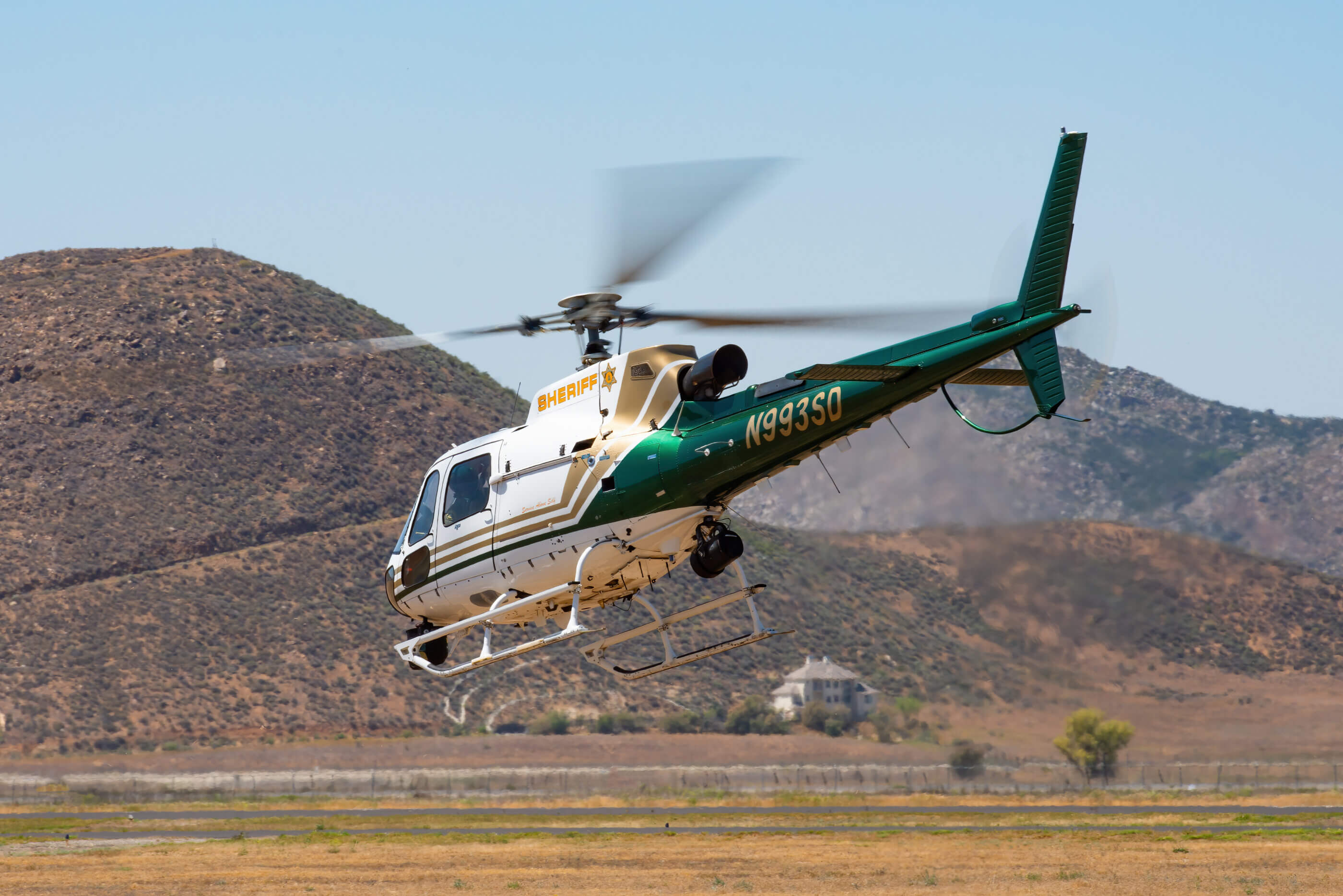
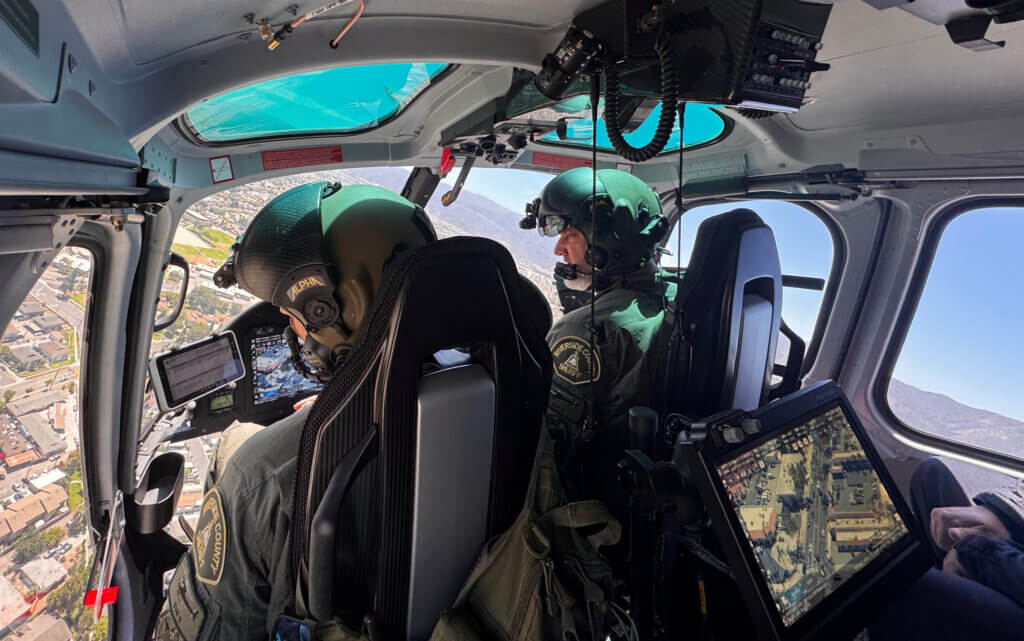
Twelve years later, as a retired police officer, host of The Hangar Z Podcast, and contributor to Vertical Valor magazine, I was invited to fly with the Riverside County Sheriff’s Office (RSO) Aviation Unit to witness the next revolutionary tool in public safety aviation: the Shotover M2 multi-sensor camera system.
The flight was a routine patrol in the RSO’s newest, state-of-the-art Airbus H125 helicopter, equipped with the latest technology available, including the newest camera and sensor system to enter the public safety market, the Shotover M2.
The M2 multi-sensor camera system is a revolutionary solution, featuring advanced stabilization and embedded augmented-reality overlays that deliver an exceptional level of situational awareness. Its six-axis design enables smooth tracking and prevents “gimbal lock” and “horizon rolling,” even when flying directly over a target.
The system’s tracking functionality allows hands-free following of vehicles and objects, and includes a feature designed to assist in identifying vehicle license plates. Its 4K recording capability allows the TFO to discern the smallest details, which are often the most critical ones.
On our first call, the M2’s capabilities were immediately apparent. The crew was asked to assist the detective bureau with a burglary investigation involving the theft of high-value items. Investigators had a suspect name and a possible location: a shopping center where the individual was reportedly sitting inside his vehicle.
Once on scene, the TFO quickly located and identified the suspect vehicle by license plate within a single orbit, using the M2’s high-resolution imagery. What was once a time-consuming task, heavily dependent on precise aircraft positioning and camera control, was now significantly streamlined by the M2’s capabilities. After confirming the vehicle, the TFO used the M2’s 4K resolution to capture a clear image of the suspect’s face and immediately transmitted it to the investigative team for verification.
The system’s technological prowess extends well beyond image capture. The RSO aircrew highlighted the M2’s ability to deliver crystal-clear imagery in challenging low-light conditions, as well as its capacity to rapidly gather and share intelligence with ground personnel. The system also integrates seamlessly with existing autopilot systems, helping reduce workload for both the pilot and the TFO.
Deputy Anthony Jimenez explained it this way: “The system is a step into a future of faster response, safer guidance to ground units, and more ease of use in the TFO position.”
The use of the M2 camera system during the incident described above enabled the rapid sharing of vital information, which the investigative team used to effectively and efficiently advance the burglary investigation.
In the rapidly evolving world of law enforcement aviation, the M2 camera system represents a quantum leap in technological capability. Riverside County Sheriff’s Aviation Unit Corporal Eric Hannum described the M2 succinctly as a “game changer,” adding that “hands down, the modern TFO is going to take the job further than anybody did in the past.”
The M2 isn’t just an upgrade — it’s a technological shift that has the potential to move law enforcement aviation units from reactive operations to proactive strategies. With future integration possibilities that include CAD, drone tracking systems, and beyond, the M2 becomes not just a camera, but a comprehensive mission management platform.
Nick Minx of Tactical Flying offers a fitting comparison: “We often utilize the functionality of high-tech mission equipment like it’s a fax machine, when in reality it has the functionality and power of a smartphone.”
This technological evolution has the potential to make today’s TFO more capable than ever before. Realizing that potential, however, will require agencies and individuals to fully adopt and embrace new technologies and processes. Through advanced training, TFOs can move beyond basic system operation to mastering complex mission management platforms — empowering them to locate suspects and make tactical decisions with greater speed, efficiency, and effectiveness.
link