New light-based communication network works on land, sea, and in air

A new light-based communication network developed through a research collaboration between Nanjing University of Posts and Telecommunications and Suzhou Lighting Chip Monolithic Optoelectronics Technology company in China makes seamless connectivity on land, in the sea, and in the air a reality.
While urban landscapes may enjoy the advantages of wireless 5G internet, many pockets worldwide still need broadband. Even as Elon Musk wants to make space-based ultra-fast internet connections the norm, the services cannot be delivered for undersea activities where research and exploration demand them.
Humanity has relied on radio wave-based communication technology for a long time, only shifting to optical communication recently. While optical communications are fast, certain limitations prevent them from facilitating seamless interconnections. The research team in China looked into the drawbacks of light-based communication. It came up with an innovative approach that makes uninterrupted connections possible.
Multi-spectra communication network
Light-based communication networks have been used in specific scenarios. They, therefore, cannot be operated across different media, such as water and air. To create a seamless network, this hurdle needed to be overcome first. The researchers, therefore, turned to four spectra of light to develop an interoperable communication network.
The team used blue light for undersea applications since seawater has a reduced absorption window for blue-green light compared to other wavelengths. This allows signals to travel farther underwater and communicate with underwater devices or buoys.
Above the water, white LEDs were used to transmit information between buoys and ships or above-water vehicles.
In the air, deep ultraviolet light was used for communication since the light spectrum is protected from interference from sunlight. In outer space, a near-infrared spectrum was used. To make the system useful in the current scenario, the researchers also created a network that allows different devices to access the Internet through a TCP/IP scheme so that devices can function as Internet of Things (IoT) terminals.
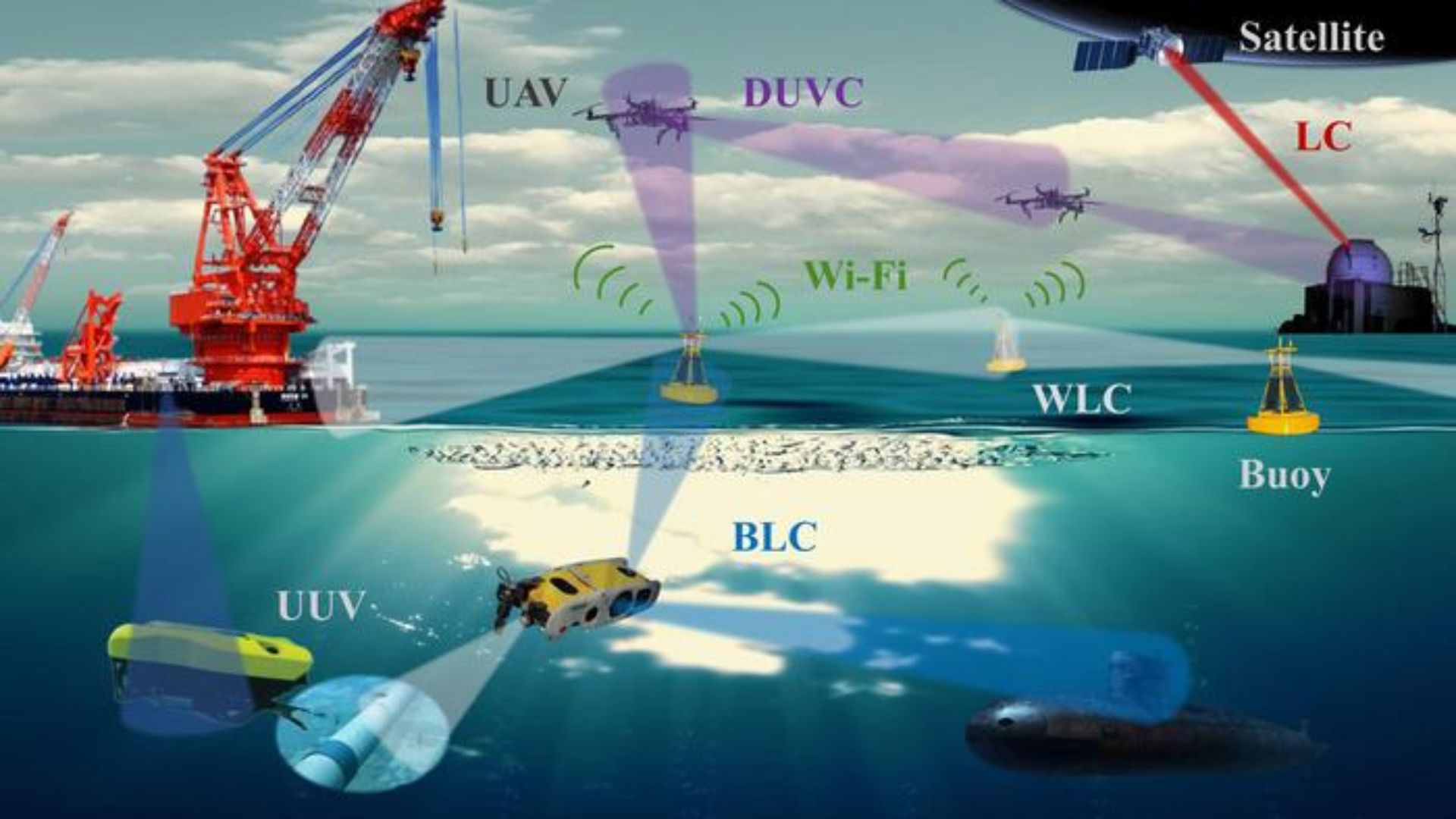
“The all-light communication could be used in oceans and lakes where sensors gather ecological data and communicate with surface buoys,” said Yongjin Wang from Nanjing University, who led the research effort. “The data could then be sent wirelessly over the water surface or across long-distance transmission links between cities. The network can also connect to the Internet granting people in a remote ocean location, access to the backbone network for information sharing.”
How well does light-based communication work?
“To make this work possible, the LEDs and the modulation schemes determine the network throughput while the avalanche photodiode limits the transmission range, and an optical bandpass filter isolates the desired light signals from those in the other spectra,” Wang added.
The researchers have successfully demonstrated that the network can accomplish full duplex real-time video communication and transmission of data, images, and audio files through wired and wireless access. A full duplex video allows content to be transmitted and received simultaneously, a requirement for applications such as video conferencing.
The researchers fed 2560 × 1440- and 1920 × 1080-pixel real-time videos into the network at 22 frames per second. They were received clearly without any lags. The maximum packet loss ratio was 5.80 percent, and the transmission delay was 74 milliseconds, as confirmed by a network packet analysis tool.
The team is currently working on enhancing the network by using wavelength division multiplexing to remove bottlenecks caused by the usage of LEDs. This will also improve the overall efficiency and performance of the network, a press release said.
The research findings were published in the journal Optical Express.
link