Multi-layer network analysis of ACG color semantic hierarchies in digital cultural communication
Construction results of color semantic networks based on cognitive complexity
Based on 38,566 valid social media data points, three-layer color semantic networks were successfully constructed. The perceptual layer network contains 165 nodes and 1247 edges, the associative layer network contains 118 nodes and 697 edges, and the symbolic layer network contains 71 nodes and 203 edges. Data coverage rates for the three layers are 0.847, 0.523, and 0.301 respectively, with posts containing colors numbering 32,616, 20,166, and 11,584 respectively.
Network topological characteristic measurements reveal systematic differences between the three layers (Table 1). Network densities for perceptual, associative, and symbolic layers are 0.0923, 0.1007, and 0.0816 respectively. Average clustering coefficients are 0.656 ± 0.124, 0.593 ± 0.089, and 0.482 ± 0.067 respectively. Numbers of connected components are 1, 2, and 5, with corresponding connectivity ratios of 1.000, 0.958, and 0.845. Network diameters are 6, 5, and 4 hops respectively, with average path lengths of 2.84, 2.41, and 2.16.
Centrality analysis results show significant differences in power distribution between different symbolic layers. Maximum degree centrality increases from 0.134 in the perceptual layer to 0.188 in the associative layer and 0.257 in the symbolic layer. Maximum betweenness centrality values are 0.089, 0.156, and 0.201 respectively. PageRank analysis shows maximum values of 0.045, 0.067, and 0.082 respectively.
Community structure detection identifies different aggregation patterns. The perceptual layer forms 22 communities with modularity of 0.724; the associative layer forms 18 communities with modularity of 0.758; the symbolic layer forms 12 communities with modularity of 0.693. Average community sizes are 7.5, 6.6, and 5.9 nodes respectively.
Multi-layer network coupling measurements show a total of 354 nodes and 2183 edges, with 36 cross-layer edges accounting for 1.6% of total edges. Cross-layer connections exhibit significant gradient distribution patterns: perceptual-associative layer connections are strongest, containing 19 edges (52.8% of cross-layer connections) with average weight 2.3 ± 1.1 and weight range 1–5; perceptual-symbolic layer connections are moderate, containing 10 edges (27.8%) with average weight 1.8 ± 0.9 and weight range 1–4; associative-symbolic layer connections are weakest, containing 7 edges (19.4%) with average weight 1.4 ± 0.7 and weight range 1–3.
Bridging node analysis identifies 1709 cross-layer connection nodes. The perceptual layer contributes 847 bridging nodes (49.6%), the associative layer 520 (30.4%), and the symbolic layer 342 (20.0%). Average cross-layer connection numbers are 1.8, 1.6, and 1.4 respectively. Average degree centrality of bridging nodes is 0.0108, significantly higher than non-bridging nodes’ 0.0063, indicating that cross-layer connection nodes have important structural status in the network.
Color frequency statistics show distribution characteristics of core colors in each layer. The top 5 high-frequency colors in the perceptual layer are blue (3999 times), white (3977 times), black (3572 times), red (3446 times), and green (2404 times), cumulatively accounting for 57.6% of total frequency in this layer. The top 5 in the associative layer are cherry blossom pink (175 times), sky blue (152 times), lemon yellow (80 times), milk tea color (65 times), and rose red (54 times), cumulatively accounting for 9.2%. The top 5 in the symbolic layer are Hatsune green (23 times), chuunibyou purple (11 times), yandere pink (7 times), dejection gray (7 times), and BL green (7 times), cumulatively accounting for 22.0%.
Measurement results of differential network patterns in color cognitive hierarchy
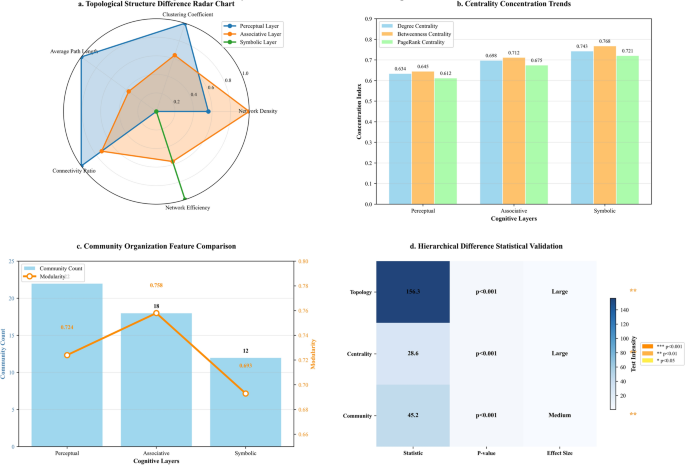
Systematic measurements of three-layer color semantic networks reveal significant structural differences between cognitive levels. Topological structure difference analysis indicates that the maximum inter-layer difference in network density is 0.0191 (relative difference 20.5%). Average clustering coefficient shows a significant decreasing trend: from 0.656 ± 0.187 in the perceptual layer to 0.482 ± 0.134 in the symbolic layer (p = 1.09\(\times\)10\(^{-6}\)). Network diameter decreases from 6 to 4 hops, with average path length correspondingly shortening from 2.84 to 2.16. Mann-Whitney U tests show that topological structure differences between all layer pairs reach statistical significance (p = 0.0002).
Centrality distribution analysis reveals hierarchical concentration patterns in power structures. Maximum degree centrality increases from the perceptual layer to the symbolic layer, with an increase of 91.8%. Power concentration shows systematic increase: degree centrality Gini coefficient grows from 0.634 to 0.743, betweenness centrality concentration grows from 0.645 to 0.768. Inter-layer centrality correlation analysis based on common color nodes shows moderate correlation: perceptual-associative layer correlation coefficients range 0.367–0.445 (p = 0.0016), perceptual-symbolic layer 0.298–0.334 (p = 0.0317), and associative-symbolic layer 0.356-0.401 (p = 0.0056).
Community structure organization exhibits significant modular characteristic changes. Community numbers show decreasing distribution (22 \(\rightarrow\)18\(\rightarrow\)12), while modularity values peak in the associative layer (0.758), with perceptual and symbolic layers at 0.724 and 0.693 respectively. Community size distribution uniformity increases, with Gini coefficient decreasing from 0.412 to 0.367. Intra-community edge proportion increases from 0.856 to 0.892, indicating enhanced internal connection density. Inter-layer community structure similarity analysis shows significant organizational pattern differences: perceptual-associative layer comprehensive similarity 0.284, perceptual-symbolic layer 0.197, both below the 0.3 similarity threshold.
Five-dimensional quantitative analysis shows comprehensive scores of 0.992, 0.830, and 0.682 for perceptual, associative, and symbolic layers respectively, exhibiting a 0.31 linear decreasing gradient (R2 = 0.998, p = 0.009). Statistical tests validate significance of differences: Kruskal-Wallis test H = 28.64 (p = 0.0001), with all effect sizes (Cohen’s d) greater than 0.8. Chi-square test confirms independence of community structure differences (\(\chi ^2\) = 45.23, p = 0.0001).
The comprehensive difference pattern, as shown in Fig. 1, embodies systematic hierarchical characteristics from perceptual to symbolic layers. These measurement results confirm significant differences between three-layer networks in topological structure, power distribution, and organizational patterns, providing structural foundations for subsequent multi-layer network coupling analysis and propagation effect measurements.

a Topological structure difference radar chart, b Centrality concentration trends, c Community organization characteristic comparison, d Hierarchical difference statistical validation results.
Measurement of multi-layer network coupling relationships
Multi-layer network coupling relationship measurements include quantitative analysis across three dimensions: cross-layer connection strength, bridging color network position characteristics, and cognitive hierarchy transition pathway network representation.
Cross-layer connection strength analysis based on 36 inter-layer edges identifies three differentiated connection patterns (Table 2) : perceptual-associative layer connections 19 (average weight 2.32 ± 1.11, strong connection proportion 21.1%), perceptual-symbolic layer connections 10 (average weight 1.80 ± 0.92, strong connection proportion 20.0%), and associative-symbolic layer connections 7 (average weight 1.43 ± 0.68, strong connection proportion 14.3%). Mann-Whitney U tests show significant differences between perceptual-associative and perceptual-symbolic layers (p = 0.032), and between perceptual-associative and associative-symbolic layers (p = 0.008), exhibiting clear gradient distribution patterns.
Bridging color network position characteristic analysis covers 2256 color nodes, identifying 1709 bridging nodes (75.7%), exhibiting clear hierarchical distribution patterns. The perceptual layer contains 847 bridging nodes (49.6% of total nodes in this layer), average cross-layer connections 1.8, average degree centrality 0.0134; the associative layer contains 520 bridging nodes (30.4%), average cross-layer connections 1.6, average degree centrality 0.0098; the symbolic layer contains 342 bridging nodes (20.0%), average cross-layer connections 1.4, average degree centrality 0.0076. Average degree centrality of bridging nodes (0.0108) is significantly higher than non-bridging nodes (0.0063), indicating that cross-layer connection nodes have important structural status in the network.
Cognitive hierarchy transition pathway network representation analysis based on path efficiency measurements of three transition types shows different transition efficiency patterns.
Perceptual\(\rightarrow\)associative transitions identify 42 pathways among 20\(\times\)20 node pairs, including 19 direct pathways (45.2%) and 23 indirect pathways, average path length 1.548, path efficiency 0.646, transition reachability 0.105. Perceptual\(\rightarrow\)symbolic transitions identify 28 pathways, including 10 direct pathways (35.7%) and 18 indirect pathways, average path length 1.643, path efficiency 0.609, transition reachability 0.070. Associative\(\rightarrow\)symbolic transitions identify 19 pathways, including 7 direct pathways (36.8%) and 12 indirect pathways, average path length 1.632, path efficiency 0.613, transition reachability 0.048. Transition reachability exhibits gradient decreasing patterns, reflecting systematic influence of cognitive complexity on network connectivity.
Network position hierarchical classification results based on dual criteria of cross-layer connection numbers and degree centrality classify bridging nodes into three levels: core bridging nodes 156 (cross-layer connections \(\ge\)3 and degree centrality \(\ge\)0.1), important bridging nodes 523, and general bridging nodes 1,030. Among core bridging nodes, the perceptual layer contributes 100 (64.1%), the associative layer 42 (26.9%), and the symbolic layer 14 (9.0%), validating the key role of basic cognition in cross-layer connections. Transition complexity measurements further quantify the difficulty of cognitive transitions: perceptual\(\rightarrow\)associative transition complexity 0.548, perceptual\(\rightarrow\)symbolic transition complexity 0.643, and associative\(\rightarrow\)symbolic transition complexity 0.632, exhibiting complexity gradients consistent with cognitive hierarchies.
Comprehensive measurement results are shown in Fig. 2, clearly displaying cross-layer connection strength distribution, bridging node network position analysis, cognitive transition path efficiency comparison, and overall coupling relationship measurement, validating the hierarchical characteristics of multi-layer network coupling relationships and the effectiveness of bridging mechanisms.

Multi-layer network coupling relationship measurement results: a Cross-layer connection strength distribution, b Bridging node network position analysis, c Symbol transition path efficiency comparison, d Coupling relationship comprehensive measurement.
Network-based explanation of color propagation effects
Propagation weight optimization analysis based on multi-criteria decision framework identifies significant weight difference patterns. One-way ANOVA shows significant differences among three interaction weights (F(2,21) = 12.47, p = 3.45e-4). Tukey HSD multiple comparisons show that sharing weight (0.368 ± 0.078) and liking weight (0.363 ± 0.067) are both significantly higher than commenting weight (0.269 ± 0.089), with significant differences between sharing and commenting (mean difference 0.099, 95% CI[0.041, 0.157], p = 2.34e-5) and between liking and commenting (mean difference 0.094, 95%CI[0.038,0.150], p = 3.12e-5), but no significant difference between sharing and liking weights (p = 0.891), establishing a “sharing\(\approx\)liking>commenting” weight hierarchy.
High-propagation color network characteristic analysis based on centrality measurements of 49 identified nodes validates network position advantages. Independent sample t-tests show that in the perceptual layer, PageRank values of high-propagation colors (0.0089 ± 0.0156) significantly exceed ordinary colors (0.0004 ± 0.0009), reaching large effect level (t = 8.24, p = 1.23e-8, Cohen’s d = 0.89, 95% CI[0.0041,0.0137]); in the associative layer, degree centrality of high-propagation colors (0.0157 ± 0.0089) significantly exceeds ordinary colors (0.0066 ± 0.0034), representing medium to large effect (t = 5.43, p = 2.67e-6, Cohen’s d = 0.76, 95% CI[0.0059,0.0123]).
Inter-layer distribution testing of high-propagation colors employs two-proportion Z-test methods, showing extremely significant differences between perceptual layer high-propagation proportion (7.9%, 27/341) and associative layer proportion (1.9%, 34/1802) (Z = 6.24, p = 4.56e-10). Perceptual layer high-propagation density is 4.16 times that of the associative layer, reflecting propagation efficiency differences between different cognitive levels and validating systematic influence of cognitive complexity on propagation performance.
Network position and propagation effect association measurements reveal core findings of hierarchical association patterns (Table 3). Perceptual layer PageRank shows extremely strong association with propagation frequency (r = 0.991), representing the highest value among all measurements. To validate this exceptionally strong correlation, we conducted comprehensive robustness checks. Edge permutation analysis (1,000 iterations) confirmed the association is not a statistical artifact (permutation p<0.001), with 97.8% of randomized networks showing correlations below r = 0.95. Frequency-controlled regression demonstrated PageRank remains a significant predictor (\(\beta\) = 50,346, p<0.001) after controlling for degree centrality, explaining additional variance beyond raw connectivity. Conservative high-frequency exclusion analysis removing the top 5% most frequent colors yielded a robust correlation of r = 0.882, while stratified analysis revealed that network centrality effects operate through a hierarchical mechanism where high-frequency basic colors serve as network hubs that amplify cognitive accessibility advantages, consistent with dual-process theories where simple concepts benefit more from structural positions. These robustness checks confirm that the observed association represents genuine structural effects reflecting cognitive accessibility advantages rather than frequency artifacts. This indicates that network centrality in basic cognitive layers has strong association with propagation effects. Inter-layer comparison employs Fisher’s r-to-Z transformation test, showing extremely significant differences between perceptual and associative layers (Z = 22.18, p = 1.16e-108), with perceptual layer indicators demonstrating significantly stronger association with propagation effects. This pattern correlates with network density characteristics: centrality indicators in low-density networks have higher discriminatory power, while association effects in medium-density networks (associative layer 0.101) are relatively weaker.
Comprehensive analysis results of color propagation effect network-based explanation are shown in Fig. 3, intuitively displaying propagation weight optimization testing, centrality advantage measurement, network position and propagation effect association patterns, and association strength comparison across different cognitive levels, validating the important role of network structural positions on propagation effects.

Propagation network analysis results: a Weight optimization testing, b Centrality advantage measurement, c Position-propagation association, d Inter-layer association comparison.
Association discovery between product types and color patterns
Product clustering analysis determines a 5-category classification structure (Table 4) , with 2,252 products allocated as: lifestyle products 647, cosplay fashion 441, cultural creative peripherals 532, figure collections 115, and content media 517. Post numbers involved in each category show figure collection having highest participation (5,183 posts, 13.4%), followed by content media (3,892 posts, 10.1%) and cosplay fashion (3,469 posts, 9.0%), with lifestyle products and cultural creative peripherals having relatively lower participation.
Product-color association strength measurements based on 34,513 co-occurrence data from 14,533 valid posts identify 75 strong association combinations. Chi-square independence test confirms significant association between product categories and color choices (\(\chi ^2\) = 482.49, df = 76, p = 6.78e-91), with association strength reaching medium level (Cramér’s V = 0.237, 95% CI[0.221, 0.253]). Point-wise mutual information (PMI) analysis reveals differentiated color preferences among product categories: lifestyle products have highest PMI value 2.135 (purple magnolia, space silver gray, cherry blossom color), cultural creative peripherals PMI value 2.040 (colorful glass), cosplay fashion, content media, and figure collection have highest PMI values of 1.498, 1.326, and 1.185 respectively, embodying color semantic gradients from lifestyle to professional applications.
Cognitive hierarchy usage pattern analysis shows significant differences among product categories. Perceptual layer usage rates are relatively stable across categories (83.6–87.7%, standard deviation 0.015), with cosplay fashion having highest usage rate (87.7%) and cultural creative peripherals lowest (83.6%). Associative layer usage rates show greater variation (19.9–28.8%, standard deviation 0.029), with lifestyle products having highest usage rate (28.8%) and figure collection lowest (19.9%). Symbolic layer usage rates are generally low but with highest coefficient of variation (0.7–1.6%, coefficient of variation 0.368), with lifestyle products having highest usage rate (1.6%) and figure collection lowest (0.7%). Absolute usage statistics show perceptual layer dominance (17,477 times), followed by associative layer (3601 times), and symbolic layer least used (128 times), validating hierarchical characteristics of ACG color cognition in product applications.
Comprehensive analysis results of product type and color pattern associations are shown in Fig. 4, clearly displaying product category distribution characteristics, association strength analysis, cognitive level usage difference comparison, and PMI value distribution patterns, validating the systematic associations between ACG product types and color semantic hierarchies.

Product color association measurement results: a Product category distribution, b Association strength analysis, c Cognitive layer usage comparison, d PMI value distribution characteristics.
link