Implementation of carrier-grade quantum communication networks over 10000 km
Network topology
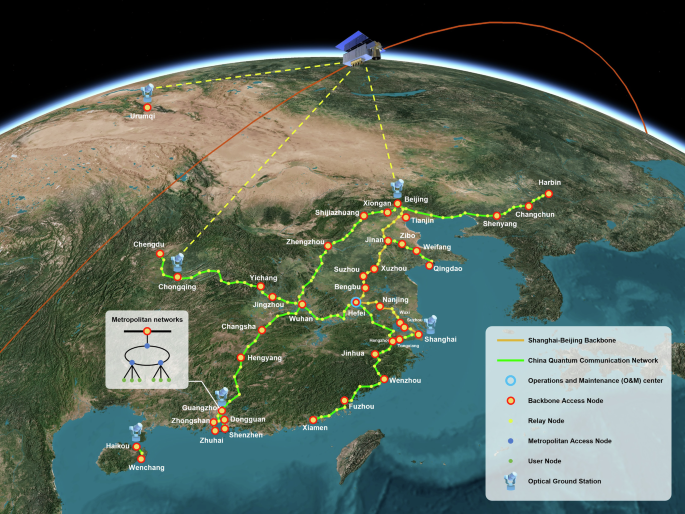
CN-QCN consists of several backbone networks and metropolitan networks. Spanning across China’s principal urban centers, the backbone network operates in coordination with BSBN to implement a distinctive “two-horizontal, two-vertical” topological framework that optimizes nationwide connectivity. Notably, Beijing, Jinan, Hefei, and Wuhan, as well as Shanghai, Hangzhou, Hefei, and Nanjing form two ring structures, enabling ring-topology protection within the QKD network. The backbone network comprises 145 fiber backbone nodes and 144 fiber links, with a total optical fiber length of approximately 10,103 km. The average distance between adjacent QKD nodes is about 70 km, with an average attenuation of 18.61 dB per link. Among the 145 backbone nodes, 41 are designated as backbone access nodes with metropolitan network access capabilities, while the remaining 104 nodes serve as relay nodes. As illustrated in Fig. 1, the green lines represent CN-QCN backbone links, the yellow lines indicate BSBN, and the red circles denote backbone access nodes, which are capable of interfacing with metropolitan networks and performing key relaying in multiple directions. The yellow dots represent trusted relay nodes located between backbone access nodes, each responsible for key forwarding to neighboring nodes.

The backbone network comprises CN-QCN (green lines) and BSBN (yellow lines). There are 145 backbone nodes, 41 (red circles) are backbone access nodes, while the remaining 104 nodes are relay nodes (yellow dots). The blue circle denotes the O&M center. In the metropolitan network, the blue dots indicate metropolitan access nodes, and green dots represent user nodes. The quantum microsatellite can connect to ground stations.
Some backbone access nodes are connected to metropolitan networks. Metropolitan networks enable users within a metropolitan region to access the QKD network and establish cross-regional interconnections via the backbone. Depending on the city scale and user distribution, several access nodes are deployed in each metropolitan network. The metropolitan access nodes are interconnected using ring or chain topologies, while the links from access nodes to user nodes adopt a tree topology. Each user node can provide quantum keys to multiple end user systems. We have deployed QKD devices and optical switches at each metropolitan access node to enable time-division multiplexing (TDM) for different user nodes. Each optical switch supports switching for up to 24 user nodes. To date, metropolitan networks have been deployed in 20 cities including Beijing, Shanghai, Jinhua, Haikou, and Chongqing, comprising 36 access nodes which are able to support more than 800 user nodes. These access nodes can be upgraded and expanded according to user demands.
The backbone nodes in Beijing, Shanghai, Guangzhou, Chongqing, Hainan, and Xinjiang are equipped with satellite ground stations. Through the Jinan-1 quantum microsatellite, key relays are established to create KM links, thereby interconnecting the satellite-ground and fiber-based QKD infrastructures. The detailed information about the Jinan-1 quantum microsatellite can be found in ref. 17.
An operation and maintenance (O&M) center has been established for the entire QKD network. It performs real-time collection of QKD performance indicators such as secure key rate, quantum bit error rate, KM-Links status, etc. It also monitors the physical environment of equipment rooms and the operation status of classical communication systems, ensuring 24/7 maintenance services for the quantum network.
To ensure the long-term stability and security of CN-QCN, the network not only uses independent server room spaces and dark fiber resources, but also deploys exclusive equipment, including Optical Transport Network (OTN) devices, Network Time Protocol (NTP) servers, network security devices and so on. These measures ensure strict network isolation between CN-QCN and the Internet, preventing information leakage and cyber-attacks. We present deployment schematics for several representative nodes in Supplementary Note 1.
Network architecture
The functional architecture of CN-QCN comprises the quantum layer, key management layer, QKD network control layer, QKD network management layer, and application layer (Fig. 2), in accordance with the ITU-T Y.3802 recommendation Quantum Key Distribution Networks—Functional Architecture18. In the quantum layer, QKD-links utilize either the decoy-state BB84 protocol19 or Gaussian-modulated continuous-variable (CV) QKD protocols20,21 to generate QKD-keys between two adjacent nodes which are subsequently delivered to the key management layer. Wavelength division multiplexers (WDM) or optical switches (OS) are used for multiplexing quantum channels. The key management layer performs key relaying based on the One-Time-Pad scheme, establishing key management links (KM-Links) between two arbitrary nodes to enable end-to-end, networked key distribution and provide key services to end user systems. Notably, each KM-Link may utilize one or more underlying QKD-Links. These KM-Links can establish both direct connections between adjacent nodes and remote connections between non-adjacent nodes via predefined key relay paths. The QKD network control layer is responsible for key routing calculation and control. It gathers real-time data on the key quantity of each KM-link, computes the optimum key relay paths according to the demand of key services and dispatches key relay policies to the corresponding KM devices. The control layer adopts a hierarchical architecture: Level-1 QKD network controllers are in charge of inter-domain routing between backbone and metropolitan networks within a given region, while Level-2 QKDN controllers are responsible for intra-domain routing of one backbone or metropolitan network. If there is a need for key relaying between different regional networks, the corresponding Level-1 controllers should coordinate the routing processes. The QKD network management layer also follows a hierarchical deployment model. The element management system (EMS) in each region collects device status from local network elements and transmits the information via northbound interfaces to the centralized network management system (NMS) located at the O&M center. This facilitates real-time status monitoring of the entire network.

The network consists of five layers: the quantum layer, the key management layer, the QKD network control layer, the QKD network management layer and the application layer. The quantum layer is responsible for key distribution between two adjacent nodes. The key management layer performs key relaying based on the One-Time-Pad scheme to complete an end-to-end key distribution. The QKD network control layer is responsible for key routing calculation and control. The QKD network management layer monitors the network status. The application layer uses the secure keys for encryption and authentication. Definitions of abbreviations, QKD: Quantum Key Distribution device; WDM: Wavelength division multiplexers; OS: Optical Switch; KM: Key Manager; QKDN-C: QKD Network Controller; EMS: Element Management System; NMS: Network Management System; User: End User System.
QKD implementation
In backbone networks, we have deployed four distinct high-speed QKD systems, all adhering to the decoy-state BB84 protocol. Three of these systems are polarization-encoding systems operating at a repetition frequency of 625 MHz (labeled as Types I, II, and III), and the other one is a phase-encoding system operating at a repetition frequency of 312.5 MHz (labeled as Type IV). Type I incorporates a single-laser scheme (for details, see Supplementary Fig. 2). In this scheme, the laser at the transmitter emits optical pulses that are modulated into decoy states by an intensity modulator, followed by a polarization encoding module to achieve modulation of four polarization states. At the receiver side, four InGaAs/InP single-photon detectors with a detection efficiency of 15% are utilized. Type II and Type III transmitters share the same structure, both employing a multi-laser scheme (as detailed in Supplementary Fig. 3), utilizing eight lasers to achieve modulation of four polarization states for signal and decoy states. At the receiver side, Type II implements four up-conversion single-photon detectors with a detection efficiency of 20%, whereas Type III utilizes four InGaAs/InP single-photon detectors with a detection efficiency of 10%. In the Type IV system (as illustrated in Supplementary Fig. 4), the transmitter primarily consists of two Sagnac interferometers and an asymmetric Mach-Zehnder interferometer, which together facilitate the intensity modulation and encoding of quantum states. The receiver employs a Faraday mirror-based Michelson interferometer for decoding, with a detection efficiency of 15%.
These QKD devices account for the primary quantum hacking strategies and have been designed with corresponding countermeasures. For instance, the decoy-state protocol has been implemented to counter photon-number-splitting attacks22; the transmitter of the QKD system is equipped with optical circulators to achieve high isolation, preventing Trojan-horse attacks23 and laser seeding attacks24. The receiver is safeguarded against time-shift attacks25 by precisely setting the detector delays. Also, an electrical monitor is included for real-time monitoring of the output current from the single-photon detectors, to counter detector blinding attacks26. Compared to multi-laser schemes, the single-laser scheme further prevents side-channel attacks that arise from the inability to maintain complete consistency in the attributes of laser wavelength, temporal characteristics and so on27.
Although the same type of QKD systems follow identical technical standards, variations in the performance of components and operating environments can still lead to differences in the secure key rates. For instance, the intrinsic quantum bit error rate may vary from 0.5% to 2% in actual environments, the dark count rate for single-photon detectors generally ranges between 600 Hz and 1000 Hz, and the error correction efficiency typically ranges from 1.2 to 2. Furthermore, the methods for calculating the secure key rate exhibit slight differences among various types of devices. Supplementary Note 2 details the system architecture, typical parameters, and secure key rate calculation method for each QKD system types.
Figure 3 illustrates the relationship between the single-pair secure key rate and quantum channel loss in the backbone network. To avoid redundant statistics under identical conditions, the figure includes data from only one pair of QKD systems selected from multiple pairs of the same type of QKD systems deployed in the same fiber link. To accurately assess the discrepancies between the actual and theoretical secure key rates, we plotted the single-pair secure key rates for identical types of QKD systems on the same graph. Subsequently, we simulated the relationship between the secure key rate and channel loss using ideal system parameters, which include an intrinsic error rate of 0.5%, a dark count rate of 600 Hz, and an error correction efficiency of 1.2. The results indicate that the actual secure key rate is lower than the theoretical value, attributable to several factors: variations in device performance due to differences in manufacturing processes; in practical applications, QKD systems are affected by temperature fluctuations and fiber vibrations, leading to reduced quantum channel stability and increased error rates; synchronization light leakage increases the noise; and fluctuations in error rates limit the optimal parameter selection for error correction algorithms, thereby reducing the efficiency of error correction. Collectively, these factors contribute to the reduction in the actual secure key rate. Nonetheless, the trend of the actual secure key rate remains consistent with the theoretical simulation results, and QKD devices operate within the linear range where the secure key rate is linearly related to the channel transmittance.

Panels (a–d) represent the system SKR for Types I, II, III, and IV, respectively. The blue lines indicate the simulated secure key rates, while the green dots represent the actual secure key rates generated by the QKD systems.
In metropolitan networks, where fiber link loss is relatively low, we have deployed a low-speed QKD system based on the decoy-state BB84 protocol (labeled as Type V), as well as two types of CV-QKD devices based on Gaussian-modulated coherent states (labeled as Types VI and VII). Type V QKD systems utilize a single-laser scheme, featuring an optical structure similar to that of Type I, operating at a repetition frequency of 40 MHz, with an intrinsic error rate ranging from 0.5% to 2%, and a detection efficiency of 10%. Type VI CV-QKD systems employ a locally-generated local oscillator (LLO) scheme, wherein the transmitter employs IQ modulation technology with a modulation variance set to 4 and a repetition frequency of 125 MHz. At the receiver, after heterodyne detection of the quantum signal and LO, bit information is yielded, with a quantum efficiency of approximately 0.43 and an electrical noise variance of about 0.2 (SNU). Type VII systems adopt a transmitted local oscillator (TLO) scheme, with a modulation variance set to 4 and a modulation rate of 10 MHz. In contrast to the LLO scheme, the TLO scheme generates the LO and quantum signal light from the same laser, which are then time and polarization multiplexed using an isolate polarization beam splitter. At the receiver, a homodyne detection scheme is employed, with a quantum efficiency of 0.6 and an electrical noise variance of approximately 0.13. Details of the system structures for Types V, VI, and VII can be found in Supplementary Note 2. In Fig. 4, we present a comparison between the actual and simulated secure key rates for Types V, VI, and VII QKD systems within metropolitan networks.

The blue, green, and red lines and dots correspond to the simulated and actual SKRs for QKD system types V, VI, and VII, respectively.
Network reliability and security
To evaluate the secure key rate performance of the backbone network, we selected the backbone network from Harbin to Shenzhen and conducted statistics over a period of 10 weeks. As shown in Fig. 5a, we present the average secure key rates of all adjacent KM-Links between Harbin and Shenzhen over this period. Among the 64 KM-Links, the minimum secure key rate was 9.75 kbps, and the maximum was 359.89 kbps. Furthermore, we segmented the link from Harbin to Shenzhen into four segments: Harbin to Beijing, Beijing to Wuhan, Wuhan to Guangzhou, and Guangzhou to Shenzhen. For each segment, the end-to-end secure key rate is determined by the minimum secure key rate among all KM-Links between adjacent nodes. The average end-to-end secure key rates for the four segments were 9.75 kbps, 16.41 kbps, 20.73 kbps, and 20.85 kbps, respectively. We also calculated the weekly average end-to-end secure key rates for these segments and depicted their variations over this period, as illustrated in Fig. 5b. The experimental results demonstrate that all segments sustained consistent secure key rates throughout the extended operation period.

a Average secure key rates of all adjacent KM-Links along the Harbin-Shenzhen path in a period of 10 weeks, with the horizontal axis indicating the abbreviations of relay node locations in the backbone network. b Weekly average end-to-end secure key rates between Harbin and Beijing, Beijing and Wuhan, Wuhan and Guangzhou, Guangzhou, and Shenzhen.
Moreover, we monitored the key service availability of 12 KM-Links between every backbone access node from Harbin to Shenzhen, as shown in Table 1. It records the service interruption durations for each of the four network segments on a weekly basis over the ten-week observation period. The results show that KM-Links from Beijing to Wuhan were always available due to the existence of redundant routing paths. In contrast, single-link topologies are more vulnerable to disruptions because of the interruption of any fiber link or the equipment failure of one node, for instance, the KM-Links from Harbin to Beijing and from Wuhan to Guangzhou. Therefore, ring-topology protection is particularly necessary for long-distance QKD backbones.
Besides, during the construction of CN-QCN, particular emphasis was placed on the overall security of the network to ensure compliance with general security standards. This is especially critical because layers above the quantum layer are no longer inherently protected by the principles of quantum mechanics. Compared to BSBN, CN-QCN incorporates more comprehensive technical safeguards and stricter management practices across five layers: physical environment, network communication, device software, application data, and security management. For example, stringent physical access control mechanisms were implemented to secure trusted relay nodes. These measures collectively enable CN-QCN to support large-scale applications in sectors such as government, finance, and energy.
link