Research on the emerging technological intervention models in design education from a strategic perspective of global design education institutions
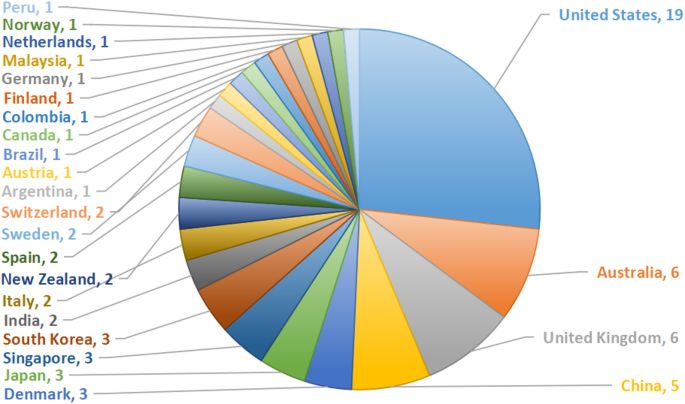
Proportion statistics of DEIs by country
According to the statistics (Fig. 1), the 71 DEIs are distributed across 25 countries spanning five continents. Among them, the United States has the largest representation, with 19 DEIs included. Following the U.S., Australia, the United Kingdom, and China each have five or more DEIs represented. Countries with three DEIs selected are mainly located in Asia, while those with two DEIs primarily come from Europe and the Asia-Pacific region. Additionally, several South American countries each have one DEI included. Overall, a higher number of North American DEIs emphasize the role of emerging technologies in the development of design education (20 out of 71), followed by European DEIs (17 out of 71), then Asian institutions (22 out of 71), and finally DEIs from Australia (8 out of 71) and South America (4 out of 71).

Statistics of DEIs by Country (Made by the Authors).
Classification of emerging technologies and their frequency of mention
Within the strategic plans of the 71 DEIs analyzed, the types of emerging technologies mentioned and their frequency of occurrence exhibit a clear hierarchical distribution (Fig. 2). This pattern reflects current priorities in the application of technology within design education, as well as future developmental trajectories. AR, VR, and AI are the most frequently referenced technologies, effectively forming the core focus of design education strategies.

Frequency statistics of emerging technology mentioned (Made by the Authors).
Following closely behind are Big Data and Data Science. These technologies play significant roles in information design, smart city development, and health monitoring, positioning them as important components in the strategic planning of design education.
Robotics and digital fabrication, including 3D printing, occupy a mid-level range in terms of frequency. These technologies are primarily associated with intelligent manufacturing and product design.
In contrast, technologies such as game technology, human-computer interaction (HCI), internet of things (IoT), generative technologies, and digital twins appear less frequently.
In sum, the variety and frequency distribution of emerging technologies in the strategic plans of the 71 DEIs reflect a diverse set of demands and evolving priorities within design education. The high frequency of intelligent, interactive, and data-driven technologies underscores the sector’s current focus, while the inclusion of mid- and low-frequency technologies indicates expanding interest.
Models of emerging technology integration in design education
This study adopts an inductive approach to summarize four distinct models through which emerging technologies are integrated into design education, and analyzes each model through case studies (Appendix 2).
Model 1: lab-driven innovation
This model emphasizes the establishment of dedicated labs to deeply integrate cutting-edge technology research with education, often leveraging Project-Based Learning (PBL) and industry partnerships to enhance the practical application of technology.
For example, the MIT Media Lab focuses on fields including AI, interactive technologies, wearable devices, VR/AR, and machine learning. It aims to explore the future of HCI while highlighting the profound societal impacts of technology. Its “Life with AI” research theme includes projects such as the Moodeng AI Challenge, which aim to foster a deeper connection between humans and nature while exploring the applications of AI in healthcare and human behavior (https://www.media.mit.edu/projects/moodeng-ai/overview/).
The Virtual Production Institute at Texas A&M University ( conducts research on extended reality (XR), VR/AR, AI, real-time 3D graphics, simulation, and digital twins. It provides immersive environments for film production, architecture, game development, and medical training, while integrating industry collaboration to ensure real-world applicability.
At the University of Chicago, the MADD Center ( concentrates on game design, data visualization, interactive media, and VR/AR. It leverages advanced facilities like the Hack Arts Lab, Weston Game Lab, and GIS Lab to explore the frontiers of AI-generated art and immersive interaction.
ImaginationLancaster ( at Lancaster University, through its ‘Beyond Imagination’ initiative, investigates the application of AI, digital worlds, and data analytics in areas such as aging societies, health, and sustainability.
The d.school at Stanford University is renowned for its focus on design thinking. Using methodologies like ‘Synthesize Information’ and ‘Experiment Rapidly,’ it explores the potential of generative AI in design innovation. For example, a chatbot named “Riff” was developed to support students in reflecting on their learning process and to foster the development of creative thinking (https://dschool.stanford.edu/stories/reflecting-with-ai?utm_source=chatgpt.com).
The Data-Driven Art Lab at the Rhode Island School of Design (RISD) is dedicated to applying AI in creative generation and artistic design, promoting deep integration of computer vision and machine learning in the arts. RISD has also partnered with AI image generation company Invoke to provide students with advanced tools for exploring the potential of AI in artistic creation (https://news.artnet.com/art-world/art-school-partners-ai-company-risd-invoke-2602338).
University of Washington houses DXARTS and HCDE labs, which specialize in experimental media research, including AI-generated art, affective computing, and social innovation. For example, the HCDE Lab has developed tools such as “AI Puzzlers” to help children think critically about AI and understand its limitations (https://www.hcde.washington.edu/news/hcde-impact/ai-puzzlers).
Model 2: industry incubation
The model of industry collaboration and technology incubation aims to cultivate students’ competencies in technology application through deep partnerships with industry, while supporting the development of AI-driven innovative products via entrepreneurship incubators. This model emphasizes practice-driven learning, enabling students to explore emerging technologies within real-world industry contexts and apply them across diverse fields such as design, computer science, user experience, and digital arts46.
At the University of Southern California (USC), the Iovine and Young Academy adopts a Challenge-Based Reflective Learning (CBRL, requiring students to directly engage in solving real industry problems in cutting-edge areas such as AI, Extended Reality (XR), and interactive technologies. This prepares students with both industry adaptability and innovative thinking.
At Manchester Metropolitan University, the School of Digital Arts (SODA) integrates AI technologies into areas like game design, animation, and user experience design, allowing students to gain hands-on industry experience and participate in real-world project partnerships. Modal gallery hosts exhibitions on game‑engine culture (e.g., using Unity and Unreal) and reveals how students and artists explore interactive, XR-informed storytelling and design prototypes in real public showcases (https://www.schoolofdigitalarts.mmu.ac.uk/modal-new-school-of-digital-arts-gallery-launches-with-game-engine-culture-exhibition/?utm_source=chatgpt.com).
TU Berlin offers a Design & Computation, M.A. program ( that emphasizes AI-generated design. Through collaborations with technical companies, the program explores topics such as the algorithmization of everyday life and the digitalization of production and labor, advancing the application of AI in design and manufacturing.
Model 3: interdisciplinary fusion
The interdisciplinary model emphasizes the close collaboration between design, computer science, and the social sciences. It aims to cultivate designers who possess both technical proficiency and humanistic insight, enabling them to carry out innovative practices within complex sociotechnical environments. The core focus of this model is to explore how technology influences society, culture, and human experience, while advancing the deep integration of design with AI, HCI, and data science.
For instance, the Design Tech ( track at Cornell University integrates disciplines such as design, HCI, digital media, computer science, and materials engineering. It explores AI-powered interaction design and data-intensive design methodologies, promoting technological innovation in design applications.
Aalto University combines art, technology, and philosophy to investigate the ‘Grey Area Between Human and Machine ( delving into the role of AI in art, gaming, and visual representation.
At the Royal College of Art (RCA), the course “Design Robotics and Gaming” merges design with AI, robotics, and gaming, training students to master frontier technologies and apply them creatively. For instance, the “Getting a Grip” project developed a soft robotic system for conducting inspections in hazardous environments; a wind turbine blade maintenance robotic arm enables remote automated repairs of wind turbine blades; the “Reminisys” initiative created an AI‑assisted wearable device designed to support individuals with dementia (https://www.rca.ac.uk/news-and-events/news/5-ways-rca-robotics-laboratory-making-world-more-safe-sustainable-and-inclusive/?utm_source=chatgpt.com).
From a social impact perspective, the Keller Center at Princeton University integrates design with social innovation, leveraging AI and data analytics to drive projects focused on public good and sustainable development.
Meanwhile, the Singapore University of Technology and Design (SUTD) prioritizes interdisciplinary development across architecture, AI, and data science. It explores AI applications in smart cities and intelligent manufacturing, promoting tech-driven urban transformation and industrial upgrading.
Model 4: curriculum integration
Some DEIs are directly embedding emerging technologies into their curricular frameworks to cultivate students with industry competitiveness. These technologies are not only explicitly mentioned in program descriptions or degree offerings, but are also embedded in course content to ensure students apply it in practice.
For example, at The University of Queensland, the Information Environments ( program emphasizes instruction in coding, data, and HCI, equipping students to use big data and digital technologies to solve real-world problems.
City University of Hong Kong offers courses in new media art, HCI, computer graphics, and AI, covering topics such as machine learning, playable media, and interactive art, aiming to nurture versatile talents with both technical and creative capabilities (https://www.scm.cityu.edu.hk/).
Meanwhile, Chang Jung Christian University integrates art and game technology in its programs on interactive art, game design, and VR/AR/XR, preparing students for roles in interface and visual interaction design (https://dweb.cjcu.edu.tw/camd/article/2462).
At Sungkyunkwan University, emerging technologies are actively incorporated into programs in information design and game design. The former leverages big data analytics to support user demand forecasting and design optimization, while the latter focuses on game art and market insight in the AI era, aiming to train the next generation of “Super Game Designers (https://art.skku.edu/eng_art/game_intro.do).”
Distribution of the 71 DEIs across the four models
As shown in Fig. 3, Model 4 accounts for the highest proportion, followed by Model 3 and 1, with Model 2 being the least represented. This indicates that most DEIs tend to integrate emerging technologies directly into course instruction. Interdisciplinary collaboration and laboratory-driven technological exploration extend classroom teaching horizontally and vertically, respectively: students are encouraged to discuss the application of emerging technologies and tools with peers from different fields across various contexts, while deepening their technical knowledge and research skills by working alongside experts in laboratory settings. Finally, only about one-tenth of the DEIs emphasize Model 2 based on emerging technologies.

Number of DEIs under the four models (Made by the Authors).

Number of Models under the Countries (Made by the Authors).
Based on the distribution of models across countries (Fig. 4), a clear pattern emerges: Germany, the Netherlands, Sweden, the UK, and the US exhibit a higher proportion of DEIs in Model 1; China and Spain have a greater share in Model 3; while Australia, Denmark, India, Italy, Singapore, South Korea, and Switzerland show elevated representation in Model 4. This reflects the differentiated attitudes among DEIs in different countries toward models of applying emerging technologies.
link