Michigan Tech Biologists Turn Icy Challenges into Resource with DARPA Project
Researchers at Michigan Tech are exploring the capabilities of ice-dwelling bacteria,
which could help the U.S. military operate more easily and safely in extremely cold
conditions.
Michigan Technological University researchers are taking advantage of the Upper Peninsula’s
watery, wintry wonderland to combat cold challenges and investigate icy infrastructure.
Ice management, harnessing the melting and freezing capabilities of ice-dwelling bacteria,
could be a means to provide the U.S. military with greater protection and increased
options in extreme cold-weather environments.
Stephen Techtmann, associate director of Michigan Tech’s Great Lakes Research Center (GLRC) and biological sciences associate professor, saw the Keweenaw Peninsula as the perfect launchpad for taking
part as performers in the U.S. Defense Advanced Research Projects Agency’s (DARPA)
Ice Control for cold Environments (ICE) program.
Techtmann is the principal investigator (PI) for the project “Ice Control Compounds from Bacterial Isolates and Functional Metagenomics,” which was awarded $798,426 in funding. The project’s goal is to explore natural
biological adaptations that control where, when and how ice crystals form. Researchers
want to understand how to prevent ice formation where it poses challenges and, conversely,
how to cause ice formation that could serve as temporary infrastructure, including
ice bridges and buildings. Researchers would then work to develop biotechnology with
those same capabilities to protect military personnel and assets while enhancing operations
in extreme cold environments.
“Living here, we’re very familiar with how ice can be a challenge,” said Techtmann.
“But we also know that ice can be a resource. We have Winter Carnival here at Tech, where students are building massive structures out of ice and snow.
Similarly, the military has challenges and opportunities in dealing with ice. What
we’re trying to do is to find ways of making solutions happen more easily and in a
way that is environmentally friendly.”
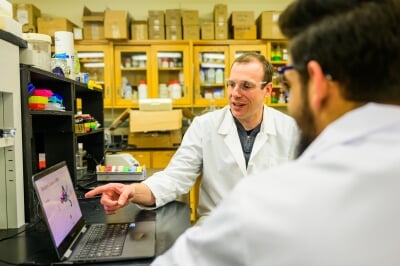
investigator for DARPA’s ICE program, looks at a data figure in his Environmental
Biotechnology Lab on Tech’s campus.
The project takes advantage of Michigan Tech’s location, building on ongoing GLRC
research into winter water systems here in the Keweenaw Peninsula.
“I’ve been working with some folks in the Great Lakes Research Center for a little
while on bacteria that live in ice, trying to understand how they adapt to those conditions
and some of the unique capabilities that they have,” said Techtmann. “When DARPA put
out the announcement looking for biological ways to manage ice formation, it seemed
like a good fit.”
Techtmann’s co-PI is Trista Vick-Majors, assistant professor of biological sciences, who has been studying microbes in the
cryosphere for over 15 years. Vick-Majors began collecting samples from Antarctic subglacial lakes as far back as 2012, and from other locations around Antarctica before that. Vick-Majors
has also worked in partnership with the GLRC since January 2021 to better understand
how these organisms partition between snow, water and ice in the Keweenaw Peninsula.
“We are interested in understanding which microbes end up in which part of that ‘winter
water system,’ why, and whether or not the ones frozen into the ice come out alive
in the spring,” said Vick-Majors.
Michigan’s Keweenaw Peninsula offers opportunities to study how microbes interact
with freezing water. Access to Lake Superior, the largest freshwater lake in the world
by surface, and to smaller inland lakes with varying depths is crucial to understanding
how microbial life interacts with ice. Michigan Tech’s GLRC provides a research base
right on the water’s edge.
“The long winters are helpful! But the abundance of water, and the diversity of water
bodies is also a big benefit of being here,” said Vick-Majors. “Ice formation can
progress differently and interact with microbes and chemicals in the water differently
based on many factors including lake size and depth and water chemistry.”
The project is deeply collaborative within Michigan Tech and beyond. Researchers at
Tech are working alongside a University of Florida team of DARPA performers led by
Associate Professor Brent Christner, an expert in icy environments studying bacterial ice nucleation.
Ice-controlling Bacteria for Snow-making and Deicing
Bacteria don’t enjoy being frozen. It’s stressful, even deadly. But they’ve adapted.
To stay alive when the water around them freezes, many bacteria produce antifreeze
molecules, such as proteins, that prevent water from freezing either inside or around
the single-celled organisms.
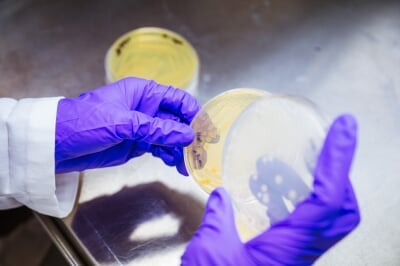
as part of the DARPA ICE program.
Other bacteria nucleate ice as a defense around their cells. Certain forms of bacteria
can cause ice crystals to form inside larger plant cells, breaking them open and allowing
plant pathogens — organisms that can cause disease in plants — to spread. Deactivated
plant pathogens such as the common Pseudomonas syringae are used in artificial snow creation at many ski resorts in warmer climates. While
the cells are dead, it’s still not optimal to release them into the environment.
On the flip side, current state-of-the-art deicing techniques for airplanes involve
dousing planes in a spray of chemicals, a cause for environmental concern.
“We don’t want to spray chemicals out in the environment, nor do we want to spray
a living organism,” said Techtmann. “So what we’re looking for is proteins or other
molecules that the cell makes that don’t have to be associated with a cell.”
There are millions of bacteria in the natural world capable of producing a wide variety
of molecules that melt or nucleate ice. Many have never been documented or fully researched.
Before Michigan Tech’s researchers can develop methods to use these molecules on a
larger scale, they have to identify which bacteria produce proteins with the desired
properties.
Techtmann said the research team’s initial goal is “to expand the diversity of what
we know about ice control proteins and organisms.” To do that, researchers are also
looking farther afield.
“What’s been fun about this project is that it funded us to go and find new things.
While this project is very much about developing specific technologies and capabilities,
we also get to go and see what exists naturally. What we’re finding now are some things
we didn’t even know existed.”
Proteins in Polar Temperatures: Sampling Bacteria in the Arctic
To build a library of viable bacteria and the proteins they create, the team has collected
bacteria from under the ice in the Keweenaw and beyond, all the way to Utqiagvik,
Alaska. Utqiagvik is the northernmost town in the United States, located 320 miles
north of the Arctic Circle.
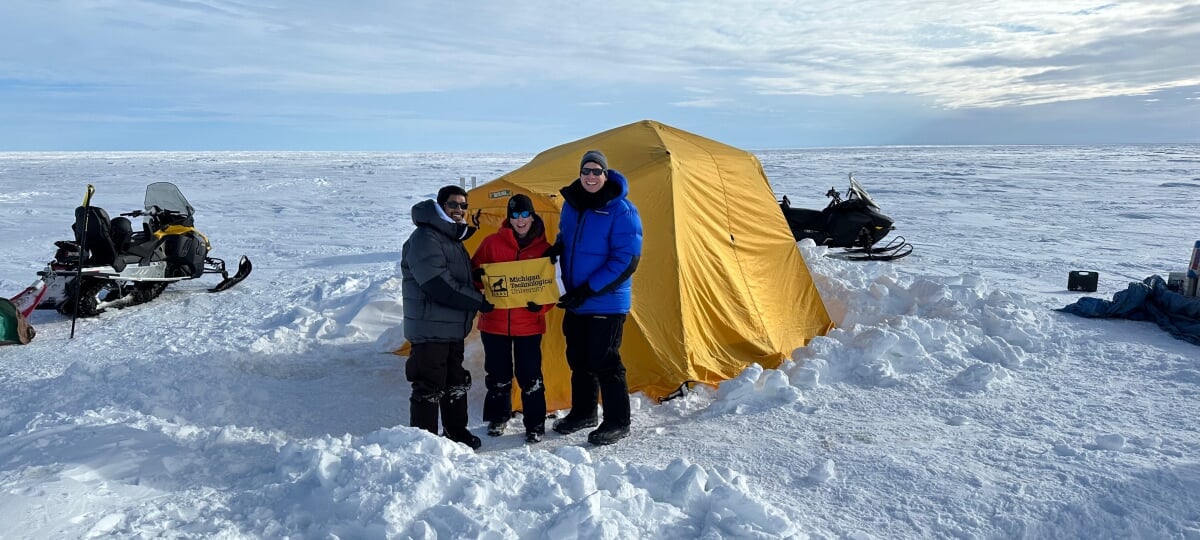
Department of Biological Sciences Ph.D. student KM Shafi came to Michigan Tech to
join Vick-Majors in DARPA ICE project field research in Alaska.
“It was an amazingly breathtaking experience from my point of view,” said Shafi. “It’s
a once-in-a-lifetime opportunity to go into the field to see how it looks in the Arctic
Circle, to experience that kind of extreme temperature.”
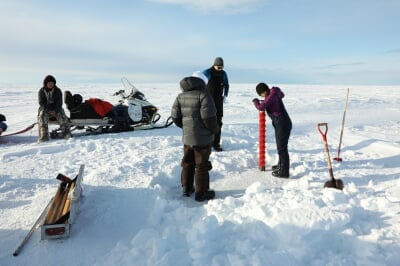
from the ice. These bacteria may be able to aid scientists in better controlling ice
melt and nucleation in an environmentally friendly way.
Advance planning was especially crucial for the expedition. Even details as seemingly
straightforward as packing and transporting all the necessary equipment had to be
conducted with precision; in such a remote location, missing one vital piece of equipment
could mean failure. Each day was painstakingly planned to maximize the number and
variety of samples the team could collect. Accessing lakes where they could take samples
required riding snowmobiles 30 to 40 minutes away from the field lab. Shafi and the
other researchers spent 10 days in a cycle — six to eight hours of sampling followed
by four to five hours of lab work — fitting in eating, sleeping and discussing their
progress after daily fieldwork was completed. The tight, demanding schedule did nothing
to deplete the Huskies’ spirits.
“Once you have done all those things there is a sense of joy,” said Shafi. “We did
a lot of the sampling that we aimed for, then we would go back to the lab and do our
work. That’s the sense of joy that I think I got for the first time as a researcher,
because the work I have done previously was not to this scale.”
The most careful planning must still bend to the will of nature. Researchers had to
adjust their plans due to unexpected weather conditions — and keep an eye out for
polar bears. Shafi said they worked with a local guide from the Ukpeagvik Inupiat
Corporation whose job included assessing threats and providing protection in case
any polar bears were encountered.
The experience taught Shafi about balancing the reality and challenges of fieldwork
with the desire to grab as much data as possible.
“Being a scientist, you want as much as you want and the conditions might not be favorable.
So you have to decide whether to go out or not, because if you go out unprepared or
in bad weather it could be very dangerous,” said Shafi.
Machine Learning and Patience: Growing Isolates from Icy Samples
Shafi’s primary role since returning from Alaska has been using the collected samples
to build a library of bacterial isolates that may produce the types of molecules researchers
are seeking. It’s easier said than done, said Shafi, who explained that typically
only about 1% of the bacteria in a given sample will grow at a large enough rate for
testing.
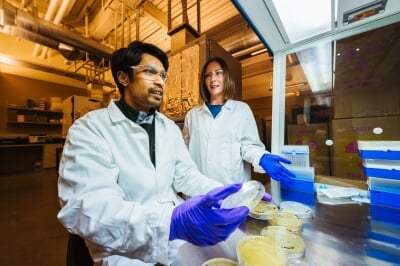
for testing.
In the Aquatic Microbial Ecology and Biogeochemistry Lab at Michigan Tech, Shafi adjusts
nutrients, growing media and temperature to work on propagating as many varieties
of bacteria as possible.
“It is really difficult to grow cultures. You have to give them the right temperature
or right amount of nutrients. Even if you’re giving them the right nutrients, the
bugs don’t want to grow,” said Shafi. “You don’t know whether they’re going to show
any activity or not. The hard part is growing them and then realizing I might grow
one or two of the isolates and none of them may work.”
A larger library means more candidates for Michigan Tech’s researchers to source antifreeze
and nucleation molecules from. Each type of bacteria may need to go through many rounds
of tests to see if it’s a viable candidate. That means Shafi must continually grow
more isolates of each bacteria to ensure enough are on hand for testing.
“Imagine you have to make tea for a hundred people one day. Then you have to make
that tea every day, or at least every two or three days,” said Shafi.
After it’s grown, each type of bacteria must be tested to see if it creates the types
of molecules needed for ice melting or making. Testing takes hundreds of hours done
manually. In Techtmann’s Environmental Biotechnology Lab, Biological Sciences master’s student and researcher Fawad Ullah is creating machine learning models to circumvent
the drawn-out process, with the goal to reduce scan time to an hour.
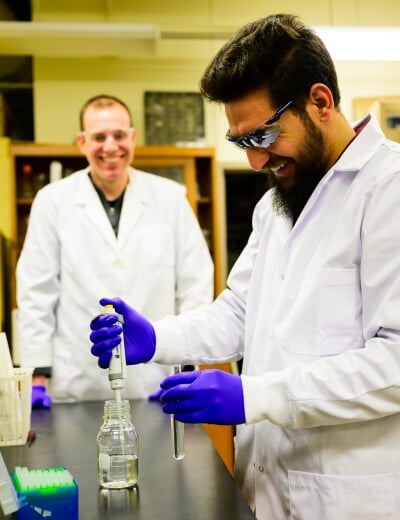
molecules that may be helpful in freezing or melting ice.
Before the models could start helping identify candidate molecules, Ullah had to teach
them what to look for, as well as what to not look for.
“The challenge was that we didn’t have much data about these proteins to start building
the learning models from,” said Ullah. Researchers first built a smaller database
of protein sequences with the desired attributes, as well as those without, then taught
the machine learning models the difference.
“Machine learning is like teaching a newborn baby. For a baby to identify a cup, we
have to show them what a cup is, what a cup looks like. In order to do that, we really
have to have some cups to show them,” said Ullah. “The other problem was that we are
trying to identify a cup, so we know what a cup looks like, but we are also trying
to identify it as separate from all other things in the world.”
From Bacteria to Biotechnology
Finding bacteria capable of producing the desired proteins isn’t the end of this research
journey. The goal is to identify proteins or other molecules that can be used for
ice nucleation or antifreeze but are not attached to bacterial cells that could contaminate
the environment. The ideal scenario would be using a small molecule, such as a short
lipid, protein or fatty acid, that could control melting and nucleation on its own.
In the case of associated bacterial cells, one possible solution researchers will
explore is attaching the candidate proteins to soil bacteria. The approach builds
on similar research using proteins as natural agricultural pesticides with low environmental
impact. That means identifying the proteins, but also how the bacteria create them.
With Shafi’s library of isolates, Ullah’s machine learning models can quickly identify
molecules with the right properties and scan bacterial metagenomes for sequences that
allow bacteria to create these molecules.
“We try to find isolates with protein molecules that are just exporting out from the
bacteria, so that we can then track them back to the source in the cell,” said Shafi.
“Is there a gene responsible for making those proteins so that we can take it to the
next level of biotechnology?”
DARPA ICE performers from Michigan Tech and Christner’s lab at the University of Florida
have collected and isolated almost 500 bacteria and identified over 2,000 antifreeze
molecules. Around 50 of the bacterial isolates identified can nucleate ice at very
warm temperatures consistently in a lab setting. Techtmann and his team are confident
at least some of these candidates are performing as well as the best nucleators currently
available on the market.
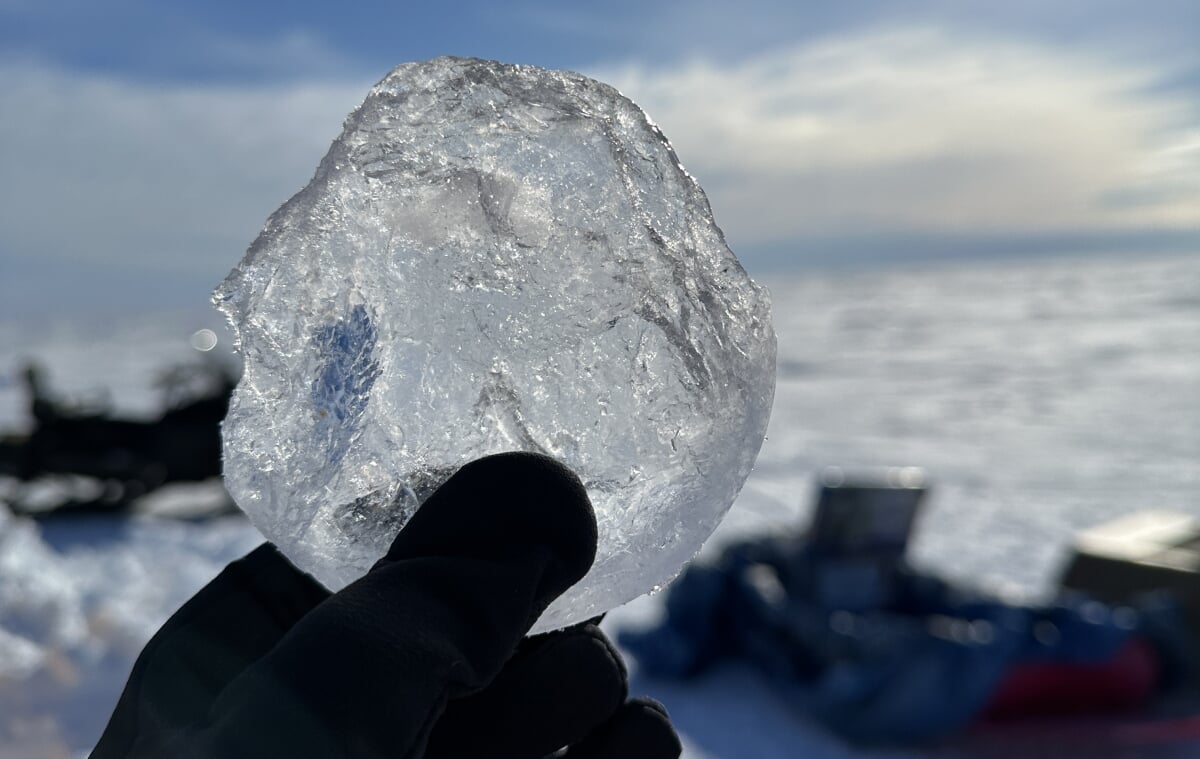
solution to DARPA’s icy problems.
“What’s really been fun scientifically is that a lot of the organisms that we are
finding that can nucleate ice are not related to what people have previously characterized,”
said Techtmann. “We’re finding some organisms that are very different and are nucleating
ice at very warm temperatures.”
With so many strong candidates to study, researchers are set up for a strong finish
to phase one of the project. They will spend the next six months exploring how these
organisms create antifreeze and nucleation molecules, and how they interact with ice
in the lab. Phase two will focus on selecting the best candidates and testing their
performance and environmental safety in more real-world conditions.
“The hope is that by the end of that two-and-a-half-year project we’ll have a few
candidates that are really effective at what they do so that we can do some field
tests,” said Techtmann.
In the Keweenaw Peninsula’s winter wonderland, where snow can fall in October and
may not disappear until April or May, Michigan Tech’s researchers will have plenty
of opportunities to test their candidate molecules in the field.
Michigan Technological University is an R1 public research university founded in 1885 in Houghton, and is home to nearly 7,500 students from more than 60 countries around the world. Consistently ranked among the best universities in the country for return on investment, Michigan’s flagship technological university offers more than 120 undergraduate and graduate degree programs in science and technology, engineering, computing, forestry, business, health professions, humanities, mathematics, social sciences, and the arts. The rural campus is situated just miles from Lake Superior in Michigan’s Upper Peninsula, offering year-round opportunities for outdoor adventure.
link