MAE research takes brain scan research to the next dimension
capable of scanning the brain three-dimensionally.
Thursday, September 25, 2025
Media Contact:
Tanner Holubar | Communications Specialist | 405-744-2065 | [email protected]
College of Engineering, Architecture and Technology researchers are using transformative
research to take neuroscience to the next dimension.
This reflects CEAT’s commitment to Oklahoma State University’s land-grant mission
by utilizing innovative research to provide solutions to real-world problems faced
by communities in Oklahoma and beyond.
Dr. Shuodao Wang, associate professor in the School of Mechanical and Aerospace Engineering,
was part of a preclinical research endeavor that was published Nature Electronics in August 2025. The project, titled “Monolithic three-dimensional neural probes from
deterministic rolling of soft electronics,” featured collaborators from OSU, Boston
University, Carnegie Mellon University, Dartmouth College, Northeastern University,
University of Pittsburgh, Weill Cornell Medical College and Boston Children’s Hospital.

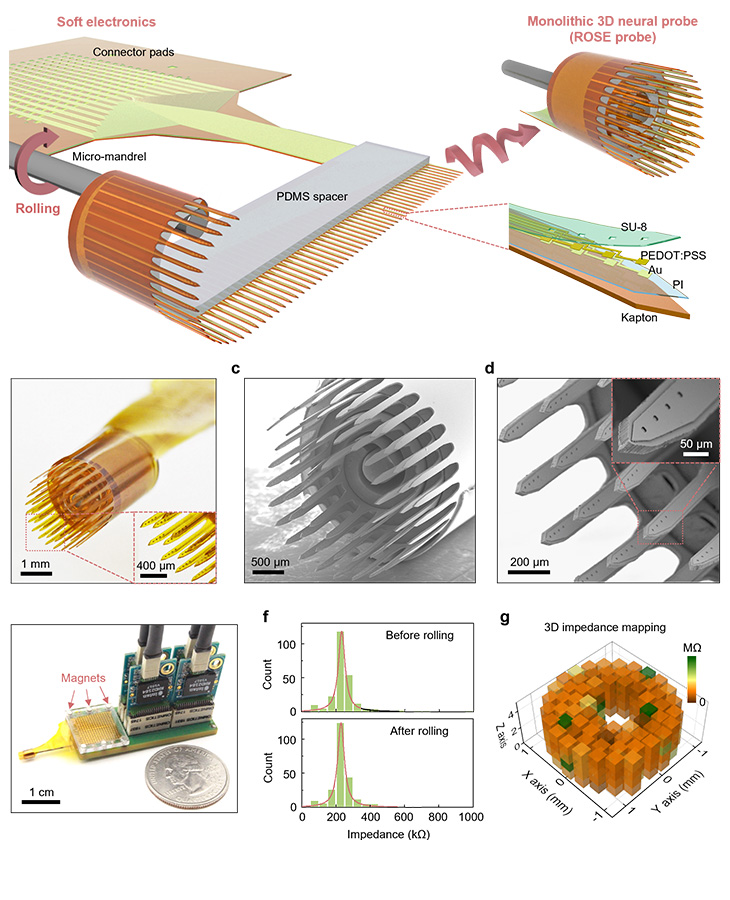
The project resulted in developing neural probe arrays that can record neural activities
in the brain at various predetermined locations and depths. These structures are carefully
crafted by rolling a flat integrated device into a 3D cylindrical shape, overcoming
challenges associated with the fragile nature of the electronics and the large deformation
during the rolling process.
Traditional 2D probes, some of which have been used since the 1970s, cannot be reshaped
and are not capable of detecting neural activities at various depths across the brain.
The probes developed in this project allow them to process information from hundreds
of specifically targeted neurons across multiple brain layers at once.
The OSU team led efforts in the mechanical design and analysis of the probes, as well
as in developing theoretical and numerical models to predict their 3D spatial positioning
after they have been rolled.
“This is crucial for determining the accurate position where neural signals are collected,”
Wang said.
In the early stages of development, the probes were able to detect the impulses of
individual neurons in rodents and non-human primates. Researchers discovered that
the 3D probes provided an extraordinary amount of detail that surpassed what was detectable
with 2D probes.
“The main innovation here is that the 3D probes enable flexibility in design to accurately
position each probe tip to a desirable depth at a specific targeted location, i.e.,
a full-field, 3D spatial mapping of the brain activities becomes possible,” Wang said.
“It is an enabling technology and a powerful tool, which will drastically advance
knowledge in the field. Its importance to neural science research is analogous to
the importance of having a microscope of higher resolution and depth of view to researchers
studying microbiological activities.”
The preclinical nature of this research means more studies and tests are needed before
the true impact of this innovation is known. Wang said activities in the prefrontal
cortex – believed to control decision-making, emotional regulation and others – where
neurons are connected over a large distance, require more study to be fully understood.
More research will also determine how nerve cells in deeper layers of one part of
the brain interact with nerve cells in the upper layers of another region of the brain.
More studies and tests are needed to explore the true impact of this innovation. Wang
said the technology will provide information on how neurons distributed over a large
area and various depths interact with each other, thereby enabling studies on the
activities in, for example, the prefrontal cortex, which is believed to control decision-making,
emotional regulation and others. With future development of devices such as optoelectrical
shank-based probes, the technology also provides a pathway toward optogenetics – or
optical stimulation of the brain.
These probes, housing hundreds of sensors and actuators, could shed new light on complex
neural processes like vision, memory, decision-making and motor control, providing
a framework for how neural networks influence behavior.
“I believe we found a very powerful tool for advancing research in neural sciences
and neural stimulation technologies,” Wang said.

link