Geared toward research: HTM faculty partner with Human Mode, ASU to study robotics in hospitality
Wednesday, September 17, 2025
Media Contact:
Stephen Howard | Director of Marketing & Communications | 405-744-4363 | [email protected]
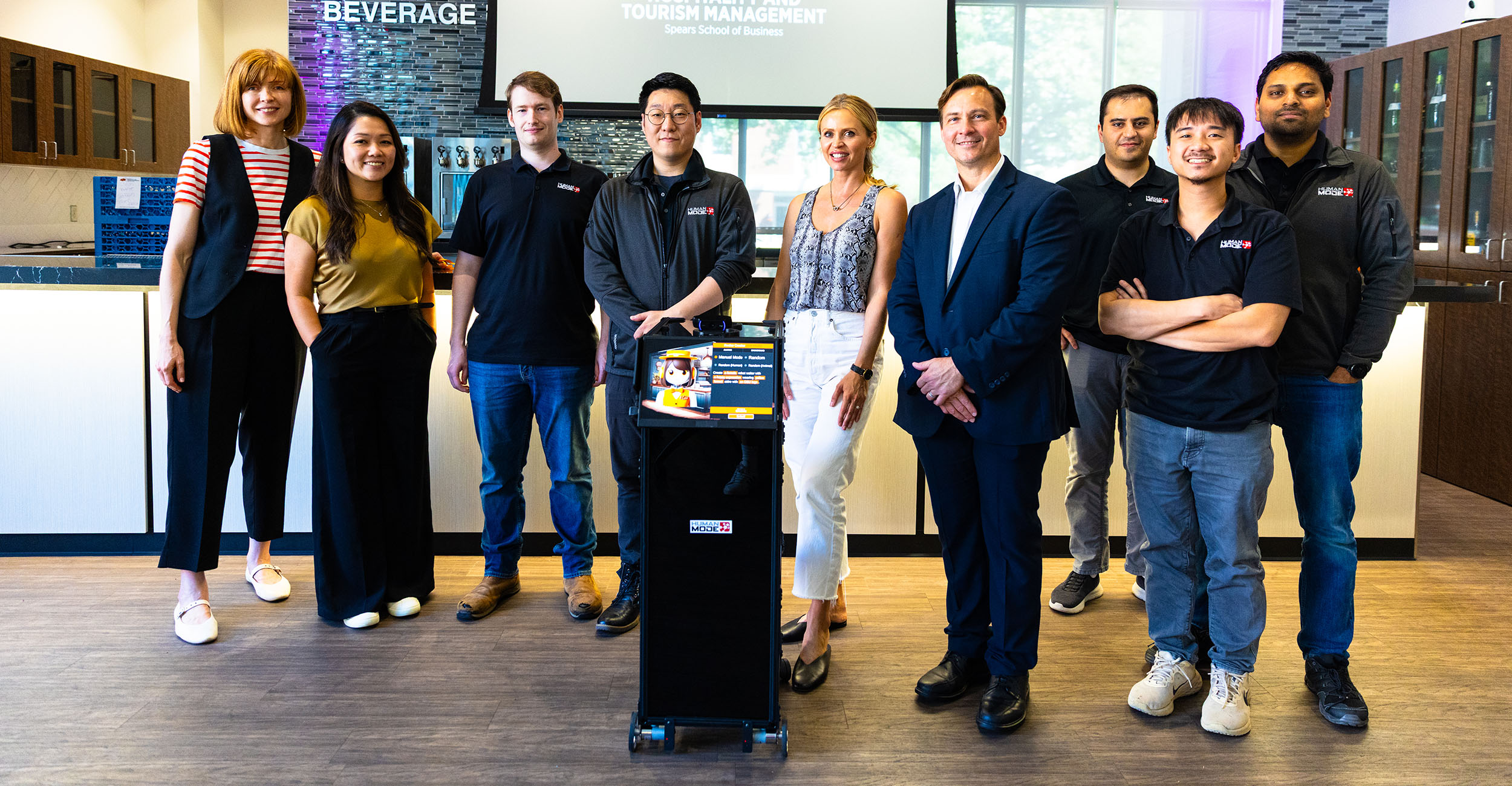
A remote-controlled robot rolled into the Wayne Hirst Center for Beverage Education on Friday afternoon.
Equipped with tiered trays, cup holders and a sleek digital interface, this machine
is a key component of Dr. Lisa Slevitch’s research.
Oklahoma State University School of Hospitality and Tourism Management faculty are partnering with Oklahoma City-based technology company Human Mode and
Arizona State University faculty on robotics research. HTM interim head Slevitch is
studying robotics in hospitality, aiming to uncover practical insights about an increasingly
relevant topic.
“We are thrilled to collaborate with Human Mode and express our sincere gratitude
for their generous support of our research efforts,” Slevitch said. “Human Mode’s
service robot technology represents exactly the kind of real-world innovation that
can transform academic research from theoretical concepts into practical applications.
This partnership exemplifies the powerful potential that emerges when industry expertise
meets academic inquiry.”
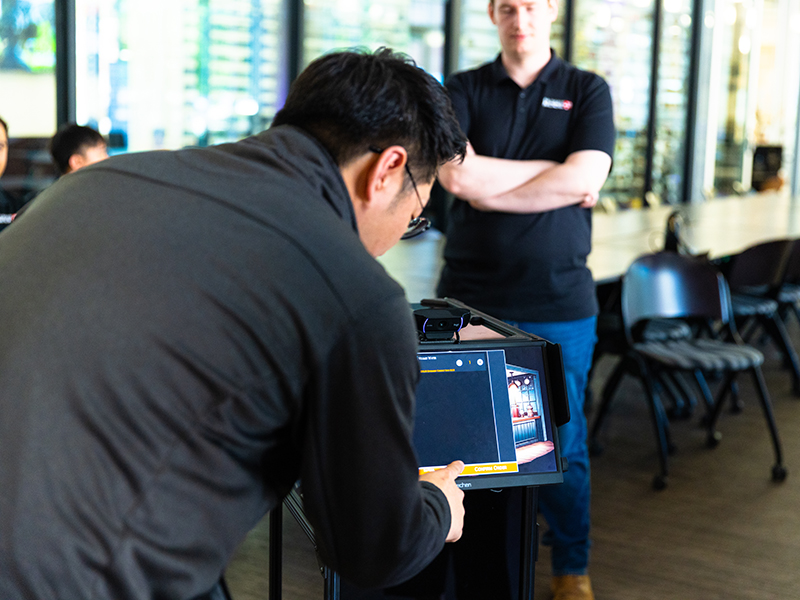
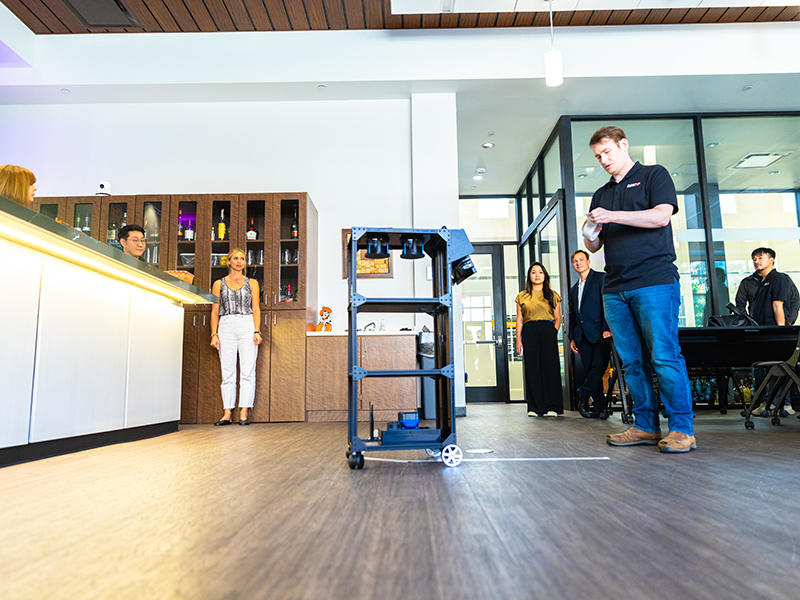
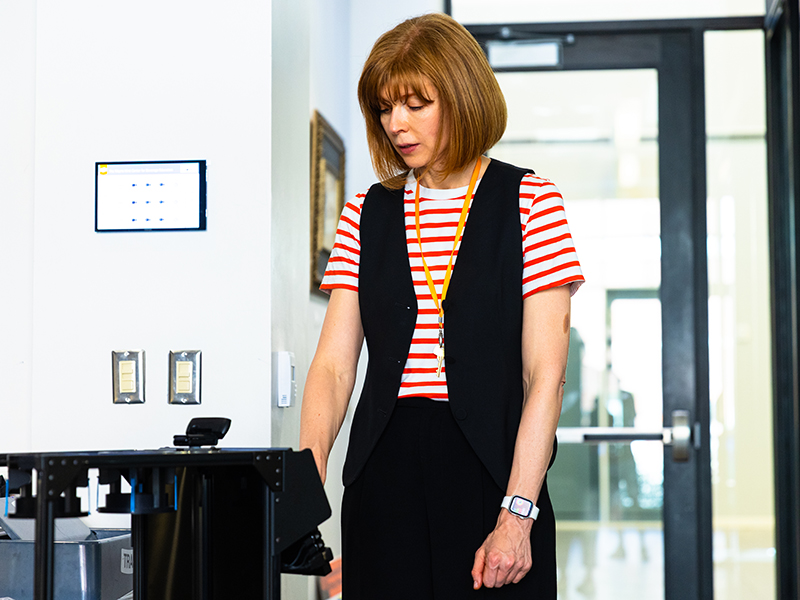
floor; Dr. Lisa Slevitch learns how to operate the robot.
Married couple William and Chi Kerber founded Human Mode in 2017 to develop robots
and advanced technologies that assist people. Human Mode built a robot for Slevitch’s
study and visited OSU to demonstrate the machine’s capabilities, showing Slevitch
how to navigate and use it.
“It’s really customizable, and it works well for this kind of research,” CEO William
Kerber said. “It’s awesome that we have the opportunity to work with OSU on this and
lend our robotics experience and software development experience to their practical,
interesting grant work.”
Housed in the Spears School of Business, OSU’s HTM program is No. 8 nationally and
No. 22 globally in ShanghaiRanking’s 2024 Global Ranking of Academic Subjects, reflecting research output and prestige. Slevitch, an associate professor who holds
the Charles W. Lanphere Chair, frequently authors publications with significant industry
applications.
She is collaborating with Drs. Katsiaryna Siamionava, Olivia Liu Sheng and Che-Wei
Liu from ASU’s highly ranked W.P. Carey School of Business. Siamionava obtained an
internal ASU research grant for this robotics work with Spears Business.
No longer relegated to science fiction, human-robot interactions are reshaping fields
that range from engineering to health care. In hospitality and tourism, service robots
are appearing alongside human employees. A recent Journal of Hospitality and Tourism Management article listed the “global hospitality robots market” value at $472.5 million in
2024 with rapid growth expected.
As technology evolves, questions and uncertainties arise. Slevitch plans to examine
human interactions with the robot’s digital interface in a restaurant setting.
“We know that robots are coming,” Slevitch said. “They’re going to be used more and
more. And, we want customers to have great experiences. There is some evidence that
it’s not always happening when humans interact with robots, so we would like to know,
what makes that interaction better?”
Although Human Mode has assembled elaborate robot hands and legged robots, the machine
for the HTM study is intentionally uncomplicated, appearing as a cart with wheels
and a digital screen. Jae Choi of Human Mode was instrumental in designing the robot’s
user-friendly interface, which allows customers to select a cartoon-style avatar.
Researchers can guide the robot with a video game-like controller, and Slevitch gained
practice during Human Mode’s demonstration. Located in OSU’s Nancy Randolph Davis Building, the Wayne Hirst Center for
Beverage Education offers an experiential learning environment ideal for conducting
this study.
“We look forward to sharing our findings and exploring the exciting possibilities
at the intersection of robotics technology and academic research,” Slevitch said.
Visit the website to learn more about OSU’s acclaimed HTM program.
link