Digital Transformation: Upstarts And Incumbents

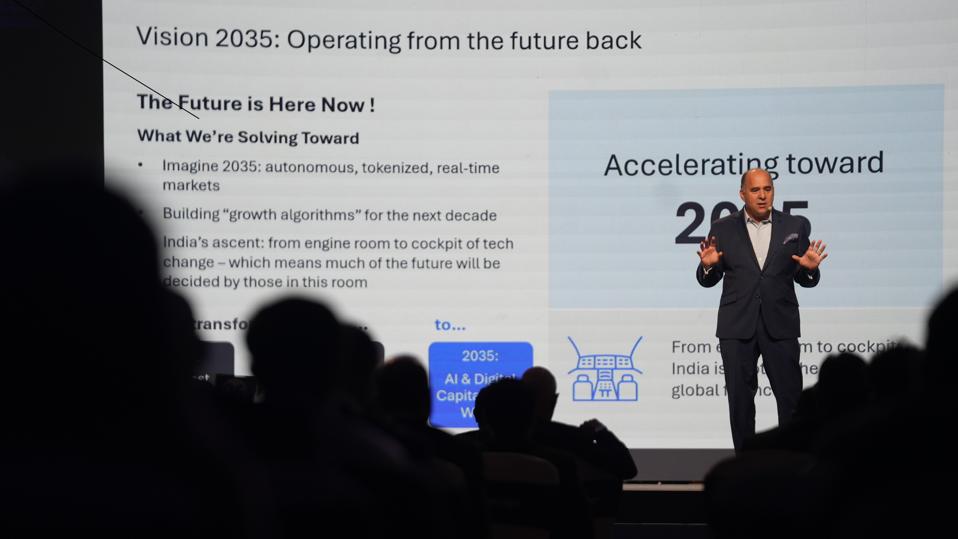
Experiencing India’s epic transformation in person caused me to step back and appreciate how quickly our own society and markets are changing.
Broadridge
I traveled to India last month to give a talk on artificial intelligence in financial services at The Economic Times World Leaders Forum in Delhi. While there, I had the pleasure of interacting with an impressive list of attendees and meeting Prime Minister Narendra Modi, who gave a rousing set of remarks about India’s rise, not only domestically but on the international stage. I also had the opportunity to spend some time in Delhi — an experience that forced me to consider some of the important changes unfolding in our financial markets and our society with a new perspective.
India is changing so fast, it seems like it’s happening right before your eyes. The country’s economy is growing so rapidly that it is projected to soon be the world’s third largest. That growth is being driven, in large part, by the world’s passion for digitization; because India missed most of the analog world, it began its digital journey before many other more advanced economies.
Prime Minister Modi launched a bold program called the Digital India Initiative in 2015 with the goal of digitizing the Indian economy. In the decade since, the initiative has made huge progress. It’s connected millions of Indian households to the internet, bringing online connectivity to remote and rural areas. It’s digitized government services and built one of the world’s best infrastructures for digital payments. By combining this infrastructure buildout with digital literacy training, the program has helped create millions of technology jobs that are lifting generations of Indian citizens into the middle class.
Of course, since India is the most populous country in the world, with roughly 1.5 billion people, even a successful initiative like this could take decades to fully materialize. However, for me, experiencing this epic transformation in person caused me to step back and appreciate how quickly our own society and markets are changing, and how much the pace of change has accelerated, not only during my lifetime, but in just the past five years. It also prompted me to look ahead and think about where all this change is leading us, especially in financial markets. And I am very pleased to say that our company, 15,000 strong, is leading the way on many of these initiatives.
Where is Rapid Change Taking Us?
My moments of reflection on the streets of Delhi led me to some dizzying conclusions. For example, based on current trajectory, it now seems inevitable that assets will soon be trading at least 20 hours per day, seven days per week. There are already several trading platforms, including Robinhood, that offer 24/5 equity trading for select stock and ETFs. Digital assets trade nonstop, 365 days a year, across global crypto exchanges like Kraken, Binance and Coinbase. Meanwhile, most global stock exchanges operate only during fixed (daytime, weekday) hours. I believe that status quo will quickly become untenable for three main reasons.
First, there will be growing demand for expanded trading. Financial markets are democratizing. In the U.S. alone, household stock ownership has increased from roughly 52% in 2013 to 58% in 2022. Those millions of new investors are used to transacting when and where they like. They won’t be satisfied with trading only during bankers’ hours.
Second, the digital trading infrastructure is built for speed. Global systems are handling surging trading volumes and complexity across asset classes. Meanwhile, tokenization, the blockchain and distributed ledger technology will soon make instantaneous settlement a reality. Broadridge’s Digital Ledger Repo platform is trading over $2 billion a day in truly tokenized digital assets, which we believe makes it the largest purely tokenized platform in fixed-income securities in the world.
Third, artificial intelligence is a universal accelerator that will eliminate inefficiencies and speed processes everywhere, including financial markets. India’s leaders understand this — and they understand the risk AI could pose to the offshoring trend that has helped fuel the country’s economic growth. Tasks that were shipped offshore will be replaced by AI, and that means millions of workers will have to upskill, ideally also using AI. For that reason, the country is investing billions of dollars into AI and related infrastructure, from hyperscalers and data centers to power generation.
Upstarts and Incumbents
That rapid pace of change in the rush to near-continuous trading is going to put huge pressure on financial services firms. In so doing, it’s also going to open the door for new waves of challengers. Fintechs and a host of other companies that might not yet be household names will someday be able to deliver a wide set of sophisticated financial tools, at scale, to millions of investors through a digital-first model.
It will be fascinating to watch how the incumbents respond. Will today’s financial services giants be able to keep pace with accelerating change and transform themselves into digital-first leaders? Or will legacy systems and mindsets slow them down to the point at which they are bypassed by upstarts?
Looking out at the lights of Delhi, it became apparent to me that India as a country is one of those digital-first up-and-comers. What does that mean for incumbents like the United States? It means it’s game on! Countries will be competing for talent, technology and capital around the world. Given the accelerating pace of change in the world today, we probably won’t have to wait long to see the results.
link