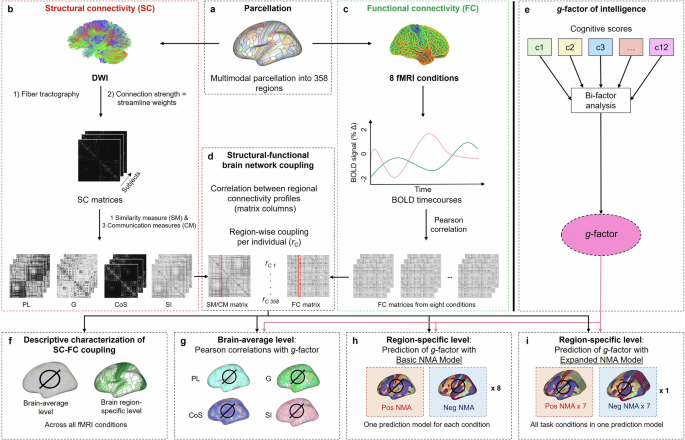
Structural-functional brain network coupling during cognitive demand reveals intelligence-relevant communication strategies
Gottfredson, L. S. Mainstream science on intelligence: an editorial with 52 signatories, history, and bibliography. Intelligence 24, 13–23 (1997).
Google Scholar
Spearman, C. General intelligence. Objectively determined and measured. Am. J. Psychol. 15, 201–293 (1904).
Google Scholar
Deary, I. J., Penke, L. & Johnson, W. The neuroscience of human intelligence differences. Nat. Rev. Neurosci. 11, 201–211 (2010).
Google Scholar
Schmidt, F. L. & Hunter, J. General mental ability in the world of work: occupational attainment and job performance. J. Pers. Soc. Psychol. 86, 162–173 (2004).
Google Scholar
Strenze, T. Intelligence and socioeconomic success: a meta-analytic review of longitudinal research. Intelligence 35, 401–426 (2007).
Google Scholar
Deary, I. J., Whiteman, M., Starr, J. M., Whalley, L. J. & Fox, H. C. The impact of childhood intelligence on later life: following up the Scottish Mental Surveys of 1932 and 1947. J. Pers. Soc. Psychol. 86, 130–147 (2004).
Google Scholar
Haier, R. J., Jung, R. E., Yeo, R. A., Head, K. & Alkire, M. T. Structural brain variation and general intelligence. NeuroImage 23, 425–433 (2004).
Google Scholar
Román, F. J. et al. Reversed hierarchy in the brain for general and specific cognitive abilities: a morphometric analysis. Hum. Brain Mapp. 35, 3805–3818 (2014).
Google Scholar
Basten, U. & Fiebach, C. Functional brain imaging of intelligence. 235–260. (2021).
Graham, S. et al. IQ-related fMRI differences during cognitive set shifting. Cereb. Cortex 20, 641–649 (2010).
Google Scholar
Hilger, K., Spinath, F. M., Troche, S. & Schubert, A.-L. The biological basis of intelligence: benchmark findings. Intelligence 93, 101665 (2022).
Google Scholar
Jung, R. E. & Haier, R. J. The Parieto-Frontal Integration Theory (P-FIT) of intelligence: converging neuroimaging evidence. Behav. Brain Sci. 30, 135–154 (2007).
Google Scholar
Duncan, J. The multiple-demand (MD) system of the primate brain: mental programs for intelligent behaviour. Trends Cogn. Sci. 14, 172–179 (2010).
Google Scholar
Basten, U., Hilger, K. & Fiebach, C. J. Where smart brains are different: a quantitative meta-analysis of functional and structural brain imaging studies on intelligence. Intelligence 51, 10–27 (2015).
Google Scholar
Haier, R. J. et al. Cortical glucose metabolic rate correlates of abstract reasoning and attention studied with positron emission tomography. Intelligence 12, 199–217 (1988).
Google Scholar
Neubauer, A. C. & Fink, A. Intelligence and neural efficiency. Neurosci. Biobehav. Rev. 33, 1004–1023 (2009).
Google Scholar
Barbey, A. K. Network neuroscience theory of human intelligence. Trends Cogn. Sci. 22, 8–20 (2018).
Google Scholar
Hilger, K. & Sporns, O. Network neuroscience methods for studying intelligence. in The Cambridge Handbook of Intelligence and Cognitive Neuroscience (eds Barbey, A. K., Haier, R. J. & Karama, S.) 26–43. (Cambridge University Press, 2021).
Friston, K. J., Frith, C. D., Liddle, P. F. & Frackowiak, R. S. Functional connectivity: the principal-component analysis of large (PET) data sets. J. Cereb. Blood Flow. Metab.13, 5–14 (1993).
Google Scholar
Hilger, K., Ekman, M., Fiebach, C. J. & Basten, U. Intelligence is associated with the modular structure of intrinsic brain networks. Sci. Rep. 7, 1–12 (2017).
Google Scholar
Hilger, K., Ekman, M., Fiebach, C. J. & Basten, U. Efficient hubs in the intelligent brain: nodal efficiency of hub regions in the salience network is associated with general intelligence. Intelligence 60, 10–25 (2017).
Google Scholar
Hilger, K., Fukushima, M., Sporns, O. & Fiebach, C. J. Temporal stability of functional brain modules associated with human intelligence. Hum. Brain Mapp. 41, 362–372 (2020).
Google Scholar
Ma, J. et al. Network attributes underlying intellectual giftedness in the developing brain. Sci. Rep. 7, 11321 (2017).
Google Scholar
Navas-Sánchez, F. J. et al. White matter microstructure correlates of mathematical giftedness and intelligence quotient. Hum. Brain Mapp. 35, 2619–2631 (2014).
Google Scholar
Dubois, J., Galdi, P., Paul, L. K. & Adolphs, R. A distributed brain network predicts general intelligence from resting-state human neuroimaging data. Philos. Trans. R. Soc. B Biol. Sci. 373, 20170284 (2018).
Google Scholar
Zhang, Z., Allen, G. I., Zhu, H. & Dunson, D. Tensor network factorizations: relationships between brain structural connectomes and traits. NeuroImage 197, 330–343 (2019).
Google Scholar
Jiang, R. et al. Task-induced brain connectivity promotes the detection of individual differences in brain-behavior relationships. NeuroImage 207, 116370 (2020).
Google Scholar
Rasero, J., Sentis, A. I., Yeh, F.-C. & Verstynen, T. Integrating across neuroimaging modalities boosts prediction accuracy of cognitive ability. PLoS Comput. Biol. 17, e1008347 (2021).
Google Scholar
Schulz, M.-A., Bzdok, D., Haufe, S., Haynes, J.-D. & Ritter, K. Performance reserves in brain-imaging-based phenotype prediction. Cell Reports 43, 113597 (2024).
Sui, J., Jiang, R., Bustillo, J. & Calhoun, V. Neuroimaging-based individualized prediction of cognition and behavior for mental disorders and health: methods and promises. Biol. Psychiatry 88, 818–828 (2020).
Google Scholar
Hawkins, D. M. The Problem of Overfitting. J. Chem. Inf. Comput. Sci. 44, 1–12 (2004).
Popp, J. L. et al. Structural-functional brain network coupling predicts human cognitive ability. NeuroImage 290, 120563 (2024).
Google Scholar
Griffa, A., Amico, E., Liégeois, R., Van De Ville, D. & Preti, M. G. Brain structure-function coupling provides signatures for task decoding and individual fingerprinting. NeuroImage 250, 118970 (2022).
Google Scholar
Medaglia, J. D. et al. Functional alignment with anatomical networks is associated with cognitive flexibility. Nat. Hum. Behav. 2, 156–164 (2018).
Google Scholar
Wang, J. et al. Alterations in brain network topology and structural-functional connectome coupling relate to cognitive impairment. Front. Aging Neurosci. 10, 404 (2018).
Google Scholar
Murray, J. D., Demirtaş, M. & Anticevic, A. Biophysical modeling of large-scale brain dynamics and applications for computational psychiatry. Biol. Psychiatry Cogn. Neurosci. Neuroimaging 3, 777–787 (2018).
Google Scholar
Suárez, L. E., Markello, R. D., Betzel, R. F. & Misic, B. Linking structure and function in macroscale brain networks. Trends Cogn. Sci. 24, 302–315 (2020).
Google Scholar
Baum, G. L. et al. Development of structure–function coupling in human brain networks during youth. Proc. Natl. Acad. Sci. USA 117, 771–778 (2020).
Google Scholar
Seguin, C., Sporns, O. & Zalesky, A. Brain network communication: concepts, models and applications. Nat. Rev. Neurosci. 24, 557–574 (2023).
Google Scholar
Zamani Esfahlani, F., Faskowitz, J., Slack, J., Mišić, B. & Betzel, R. F. Local structure-function relationships in human brain networks across the lifespan. Nat. Commun. 13, 2053 (2022).
Google Scholar
DeYoung, C. G. et al. Reproducible between-person brain-behavior associations do not always require thousands of individuals. Preprint at (2022).
Marek, S. et al. Reproducible brain-wide association studies require thousands of individuals. Nature 603, 654–660 (2022).
Google Scholar
Avena-Koenigsberger, A., Misic, B. & Sporns, O. Communication dynamics in complex brain networks. Nat. Rev. Neurosci. 19, 17–33 (2018).
Google Scholar
Goñi, J. et al. Resting-brain functional connectivity predicted by analytic measures of network communication. Proc. Natl. Acad. Sci. USA 111, 833–838 (2014).
Google Scholar
Seguin, C. et al. Communication dynamics in the human connectome shape the cortex-wide propagation of direct electrical stimulation. Neuron 111, 1391–1401.e5 (2023).
Google Scholar
Vázquez-Rodríguez, B. et al. Gradients of structure–function tethering across neocortex. Proc. Natl. Acad. Sci. USA 116, 21219–21227 (2019).
Google Scholar
Finn, E. S. & Bandettini, P. A. Movie-watching outperforms rest for functional connectivity-based prediction of behavior. NeuroImage 235, 117963 (2021).
Google Scholar
Finn, E. S. et al. Can brain state be manipulated to emphasize individual differences in functional connectivity?. NeuroImage 160, 140–151 (2017).
Google Scholar
Chen, J. et al. Shared and unique brain network features predict cognitive, personality, and mental health scores in the ABCD study. Nat. Commun. 13, 2217 (2022).
Google Scholar
Greene, A. S., Gao, S., Scheinost, D. & Constable, R. T. Task-induced brain state manipulation improves prediction of individual traits. Nat. Commun. 9, 2807 (2018).
Google Scholar
Greene, A. S., Gao, S., Noble, S., Scheinost, D. & Constable, R. T. How tasks change whole-brain functional organization to reveal brain-phenotype relationships. Cell Rep. 32, 108066 (2020).
Google Scholar
Van Essen, D. C. et al. The WU-Minn human connectome project: an overview. NeuroImage 80, 62–79 (2013).
Google Scholar
Human Connectome Project Consortium. WU-Minn HCP 1200 Subject Data Release [Dataset]. ConnectomeDB. (2017).
Snoek, L. et al. The Amsterdam Open MRI Collection, a set of multimodal MRI datasets for individual difference analyses. Sci. Data 8, 85 (2021).
Google Scholar
Snoek, L. et al. AOMIC—PIOP1 [Dataset]. OpenNeuro (2020).
Snoek, L. et al. AOMIC—PIOP2 [Dataset]. OpenNeuro (2020).
Schmid, J. & Leiman, J. M. The development of hierarchical factor solutions. Psychometrika 22, 53–61 (1957).
Google Scholar
Glasser, M. F. et al. A multi-modal parcellation of human cerebral cortex. Nature 536, 171–178 (2016).
Google Scholar
Raven, J. C., Court, J. H. & Raven, J. Manual for Raven’s Progressive Matrices and Vocabulary Scales: Standard Progressive Matrices (Oxford Psychologists Press, 1996).
Raven, J. The Raven’s progressive matrices: change and stability over culture and time. Cogn. Psychol. 41, 1–48 (2000).
Google Scholar
Birn, R. M. et al. The effect of scan length on the reliability of resting-state fMRI connectivity estimates. NeuroImage 83, 550–558 (2013).
Google Scholar
Fields, R. D. White matter in learning, cognition and psychiatric disorders. Trends Neurosci. 31, 361–370 (2008).
Google Scholar
Hermundstad, A. M. et al. Structural foundations of resting-state and task-based functional connectivity in the human brain. Proc. Natl. Acad. Sci. USA110, 6169–6174 (2013).
Google Scholar
Cole, M. W., Bassett, D. S., Power, J. D., Braver, T. S. & Petersen, S. E. Intrinsic and task-evoked network architectures of the human brain. Neuron 83, 238–251 (2014).
Google Scholar
Thiele, J. A., Faskowitz, J., Sporns, O. & Hilger, K. Multitask brain network reconfiguration is inversely associated with human intelligence. Cereb. Cortex (2022).
Betzel, R. F., Faskowitz, J., Mišić, B., Sporns, O. & Seguin, C. Multi-policy models of interregional communication in the human connectome. Preprint at (2022).
Gu, Z., Jamison, K. W., Sabuncu, M. R. & Kuceyeski, A. Heritability and interindividual variability of regional structure-function coupling. Nat. Commun. 12, 4894 (2021).
Google Scholar
Krienen, F. M., Yeo, B. T. T. & Buckner, R. L. Reconfigurable task-dependent functional coupling modes cluster around a core functional architecture. Philos. Trans. R. Soc. Lond. B Biol. Sci. 369, 20130526 (2014).
Google Scholar
Smith, S. M. et al. Correspondence of the brain’s functional architecture during activation and rest. Proc. Natl. Acad. Sci. USA106, 13040–13045 (2009).
Google Scholar
Fox, M. D. & Raichle, M. E. Spontaneous fluctuations in brain activity observed with functional magnetic resonance imaging. Nat. Rev. Neurosci. 8, 700–711 (2007).
Google Scholar
Barch, D. M. et al. Function in the human connectome: task-fMRI and individual differences in behavior. NeuroImage 80, 169–189 (2013).
Google Scholar
Sripada, C., Angstadt, M., Rutherford, S., Taxali, A. & Shedden, K. Toward a “treadmill test” for cognition: improved prediction of general cognitive ability from the task activated brain. Hum. Brain Mapp. 41, 3186–3197 (2020).
Google Scholar
Neisser, U. et al. Intelligence: knowns and unknowns. Am. Psychol. 51, 77–101 (1996).
Google Scholar
Zhao, W. et al. Task fMRI paradigms may capture more behaviorally relevant information than resting-state functional connectivity. NeuroImage 270, 119946 (2023).
Google Scholar
Corr, P. J., DeYoung, C. G. & McNaughton, N. Motivation and personality: a neuropsychological perspective. Soc. Personal. Psychol. Compass 7, 158–175 (2013).
Google Scholar
DeYoung, C. G. Cybernetic Big Five Theory. J. Res. Personal. 56, 33–58 (2015).
Google Scholar
Hilger, K. & Markett, S. Personality network neuroscience: promises and challenges on the way toward a unifying framework of individual variability. Netw. Neurosci.5, 631–645 (2021).
Google Scholar
Elliott, M. L. et al. General functional connectivity: shared features of resting-state and task fMRI drive reliable and heritable individual differences in functional brain networks. NeuroImage 189, 516–532 (2019).
Google Scholar
Gao, S., Greene, A. S., Constable, R. T. & Scheinost, D. Combining multiple connectomes improves predictive modeling of phenotypic measures. NeuroImage 201, 116038 (2019).
Google Scholar
Hastie, T., Tibshirani, R. & Friedman, J. The Elements of Statistical Learning (Springer, 2009).
Haier, R. J. The Neuroscience of Intelligence (Cambridge University Press, 2023).
Haier, R. J. The Neuroscience of Intelligence (Cambridge University Press, 2016).
Kovacs, K. & Conway, A. R. A. Process overlap theory: a unified account of the general factor of intelligence. Psychol. Inq. 27, 151–177 (2016).
Google Scholar
Jiang, R. et al. Multimodal data revealed different neurobiological correlates of intelligence between males and females. Brain Imaging Behav. 14, 1979–1993 (2020).
Google Scholar
Zhang, Y.-D. et al. Advances in multimodal data fusion in neuroimaging: overview, challenges, and novel orientation. Inf. Fusion 64, 149–187 (2020).
Google Scholar
Steegen, S., Tuerlinckx, F., Gelman, A. & Vanpaemel, W. Increasing transparency through a multiverse analysis. Perspect. Psychol. Sci.11, 702–712 (2016).
Google Scholar
DeYoung, C. G. et al. Beyond Increasing Sample Sizes: Optimizing Effect Sizes in Neuroimaging Research on Individual Differences. Journal of Cognitive Neuroscience 37, 1023–1034 (2025).
Nebe, S. et al. Enhancing precision in human neuroscience. eLife 12, e85980 (2023).
Google Scholar
Noble, S., Scheinost, D. & Constable, R. T. A decade of test-retest reliability of functional connectivity: a systematic review and meta-analysis. NeuroImage 203, 116157 (2019).
Google Scholar
Thomas, C. et al. Anatomical accuracy of brain connections derived from diffusion MRI tractography is inherently limited. Proc. Natl. Acad. Sci. USA111, 16574–16579 (2014).
Google Scholar
Wu, D., Li, X. & Jiang, T. Reconstruction of behavior-relevant individual brain activity: an individualized fMRI study. Sci. China Life Sci. 63, 410–418 (2020).
Google Scholar
Thiele, J. A., Faskowitz, J., Sporns, O. & Hilger, K. Choosing explanation over performance: insights from machine learning-based prediction of human intelligence from brain connectivity. PNAS Nexus 3, pgae519 (2024).
Google Scholar
Dunst, B. et al. Neural efficiency as a function of task demands. Intelligence 42, 22–30 (2014).
Google Scholar
Neubauer, A. C., Fink, A. & Schrausser, D. G. Intelligence and neural efficiency: the influence of task content and sex on the brain–IQ relationship. Intelligence 30, 515–536 (2002).
Google Scholar
Parkes, L., Fulcher, B., Yücel, M. & Fornito, A. An evaluation of the efficacy, reliability, and sensitivity of motion correction strategies for resting-state functional MRI. NeuroImage 171, 415–436 (2018).
Google Scholar
Jenkinson, M., Bannister, P., Brady, M. & Smith, S. Improved optimization for the robust and accurate linear registration and motion correction of brain images. NeuroImage 17, 825–841 (2002).
Google Scholar
Cucina, J. & Byle, K. The bifactor model fits better than the higher-order model in more than 90% of comparisons for mental abilities test batteries. J. Intell. 5, 27 (2017).
Google Scholar
Kan, K.-J., Psychogyiopoulos, A., Groot, L. J., de Jonge, H. & ten Hove, D. Why do bi-factor models outperform higher-order g factor models? A network perspective. J. Intell. 12, 18 (2024).
Google Scholar
Glasser, M. F. et al. The minimal preprocessing pipelines for the Human Connectome Project. NeuroImage 80, 105–124 (2013).
Google Scholar
Tournier, J.-D., Calamante, F. & Connelly, A. Robust determination of the fibre orientation distribution in diffusion MRI: non-negativity constrained super-resolved spherical deconvolution. NeuroImage 35, 1459–1472 (2007).
Google Scholar
Dhollander, T. et al. Multi-tissue log-domain intensity and inhomogeneity normalisation for quantitative apparent fibre density. In Proc. 29th Int. Soc. Magn. Reson. Med. Vol. 29, 2472 (2021).
Civier, O., Smith, R. E., Yeh, C.-H., Connelly, A. & Calamante, F. Is removal of weak connections necessary for graph-theoretical analysis of dense weighted structural connectomes from diffusion MRI?. NeuroImage 194, 68–81 (2019).
Google Scholar
Tournier, J.-D. et al. MRtrix3: a fast, flexible and open software framework for medical image processing and visualisation. NeuroImage 202, 116137 (2019).
Google Scholar
Smith, R. E., Tournier, J.-D., Calamante, F. & Connelly, A. Anatomically-constrained tractography: improved diffusion MRI streamlines tractography through effective use of anatomical information. NeuroImage 62, 1924–1938 (2012).
Google Scholar
Smith, R. E., Tournier, J.-D., Calamante, F. & Connelly, A. SIFT: spherical-deconvolution informed filtering of tractograms. NeuroImage 67, 298–312 (2013).
Google Scholar
Tournier, J.-D., Calamante, F. & Connelly, A. MRtrix: diffusion tractography in crossing fiber regions. Int. J. Imaging Syst. Technol. 22, 53–66 (2012).
Google Scholar
Cole, M. W. et al. Task activations produce spurious but systematic inflation of task functional connectivity estimates. NeuroImage 189, 1–18 (2019).
Google Scholar
Smith, S. M. et al. Resting-state fMRI in the Human Connectome Project. NeuroImage 80, 144–168 (2013).
Google Scholar
Popp, J. L. SC_FC_Coupling_Task_Intelligence (v1.0.0). Zenodo (2024).
Han, J., Kamber, M. & Pei, J. 2—Getting to know your data. in Data Mining 3rd edn (eds Han, J., Kamber, M. & Pei, J.) 39–82 (Morgan Kaufmann, 2012).
Estrada, E. & Hatano, N. Communicability in complex networks. Phys. Rev. E Stat. Nonlinear Soft Matter Phys. 77, 036111 (2008).
Google Scholar
Rosvall, M., Grönlund, A., Minnhagen, P. & Sneppen, K. Searchability of networks. Phys. Rev. E 72, 046117 (2005).
Google Scholar
link