


Thursday, January 29, 2026
Media Contact:
Tanner Holubar | Communications Specialist | 405-744-2065 | tanner.holubar@okstate.edu
Researchers are testing a newly discovered class of advanced ceramics to see how well
the material withstands extreme radiation, a key step in safer nuclear energy and
more durable materials.
The College of Engineering, Architecture and Technology is involved in a research effort to
discover new materials that perform better under these conditions.


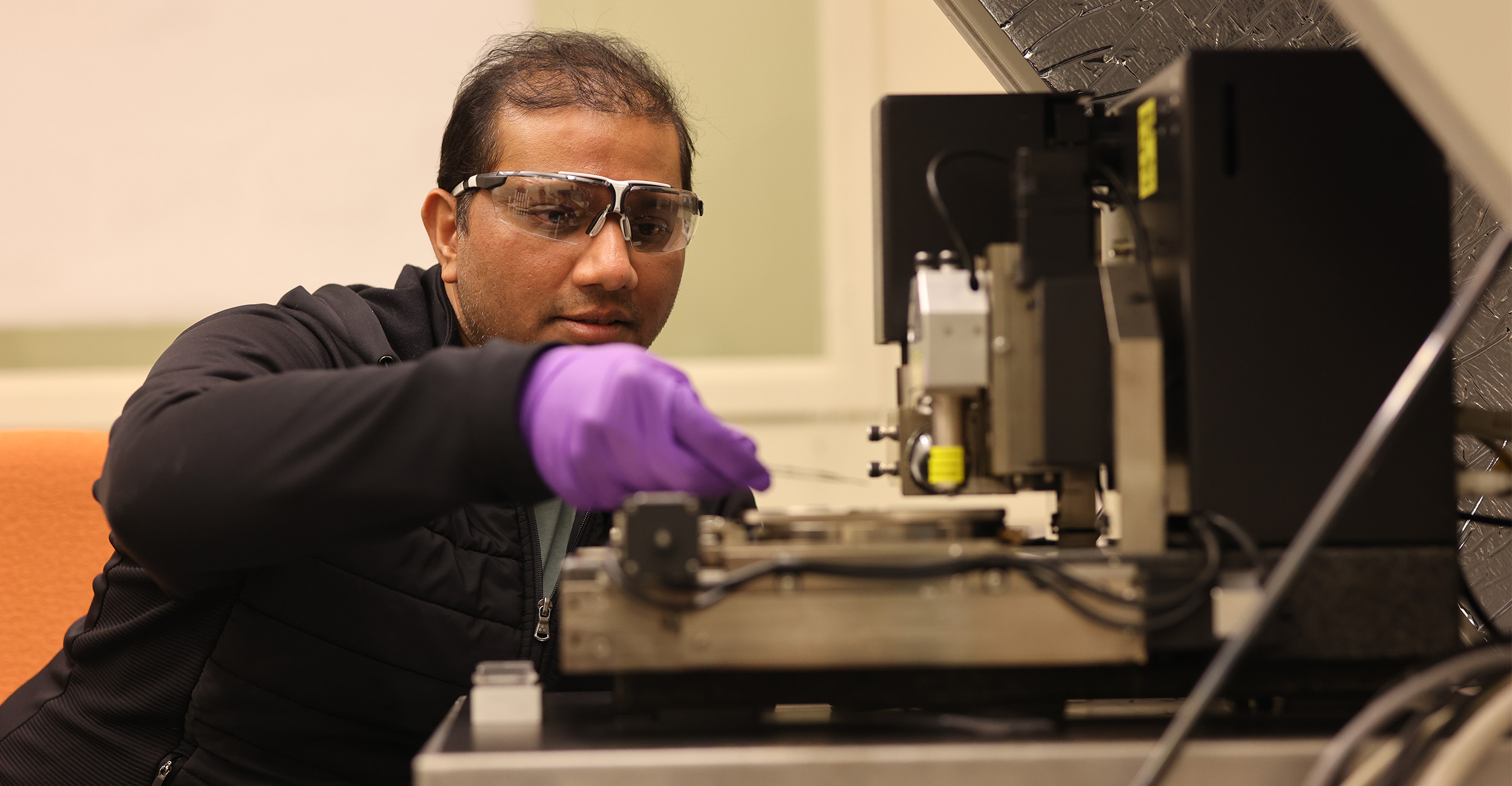
assistants on his research team, stand in Sachan’s lab in the Advanced Technology
Research Center.
Dr. Ritesh Sachan, an assistant professor in the School of Mechanical and Aerospace
Engineering, is the lead on a collaboration with the U.S. Department of Energy for
a $440,000 project titled “Atomic-scale understanding of irradiation-induced order/disorder
transformations in high-entropy oxides.”
As part of the DOE’s Basic Energy Sciences program, this project is fundamental research
aimed at understanding the core phenomena of high-entropy oxides. These are a recently
discovered class of materials that are made by combining five or more elements within
the same atomic structure.
After being exposed to radiation and seeing how the atoms respond, the team seeks to
discover new materials as well as why some resist damage better than others. When
viewed at the atomic level, these materials appear like cubes stacked on top of each
other. High-entropy oxides appear more randomly organized.
“When you have this type of random arrangement of these elements, it has been found
that they do not behave like conventional metals or ceramics,” Sachan said. “Their
properties have so heavily transformed that they can potentially have more resistance
to high temperatures, radiation or they can withstand some higher level of corrosion.
So, there are multiple applications that you can use these high-entropy materials
to achieve.”
Researchers in this space have recently started focusing more on how ceramic materials
behave when irradiated, which is an area of expertise for Sachan. His team will use
pulsed laser deposition to create thin films of high-entropy oxides, allowing the
team precise control over the composition and crystal orientation of the material.
This will allow them to systematically study a large variety of compositions and see
how each was uniquely impacted by radiation.
“In a single experiment, we can create many different types of samples,” Sachan said.
“We can create a huge library of maybe 50 different compositions at one time with
pulsed laser deposition. We can then accelerate the discovery of this radiation behavior
and face transformations between atoms.”
Radiation can form defects such as vacancies, grain boundaries or displaced atoms
within the atomic lattice structure, leading to disorder at the atomic scale.

The team hopes to understand if radiation preserves atomic order, partially disrupts it or
totally transforms the atomic structure. This will help set a foundation for understanding
how radiation interacts with high-entropy oxides at the atomic scale.
While fundamental, this research sets the stage for a multitude of future applications.
From nuclear energy to space environments, the understanding uncovered by this research
will be a building block for the expanded understanding of high-entropy oxides.
“We can do this radiation study and foster a fundamental understanding that can be
scaled up in the future,” Sachan said. “This could allow for the creation of some
more radiation-resistant materials.”
The team is collaborating with Oak Ridge National Laboratory, the University of Tennessee
and Texas A&M University. The materials will first be created by Sachan’s team, sent
to be irradiated and then sent back. They will compare the before and after data to
determine what alterations the radiation has caused.
This research is a hallmark of OSU in undertaking an approach toward fundamental research
that can have long-lasting implications. Sachan’s team is answering the Cowboy Code
by meeting this research head-on to lay a foundation for future innovative exploration.
link