


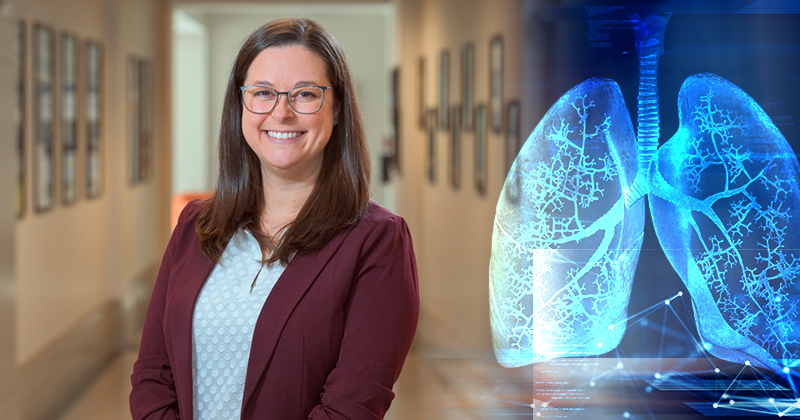
Photo illustration by Jeffrey C. Chase | Photos by Kathy F. Atkinson | Video by Ally Quinn and Sam Kmiec
November 11, 2025
Editor’s note: The University of Delaware is diligently working to enhance infrastructure and support available to campus innovators. As part of this effort, the U.S. National Science Foundation’s Accelerating Research Translation program (NSF ART program) at UD is investing in capacity-building resources to boost the translation of UD research discoveries into novel technologies of benefit to Delawareans and the nation. UD is an inaugural member of the NSF ART program.
It’s been a busy few years for University of Delaware inventor Catherine Fromen, Centennial Term Professor for Excellence in Research and Education and associate professor of chemical and biomolecular engineering and biomedical engineering.
Since joining the UD faculty in 2017, Fromen has built a thriving research program, developed moving models for studying the way inhaled medicines disperse in the lungs and gut, and engineered novel ways to capture data about how aerosols deposit in the lungs. It’s an important area of study with the ability to impact hard-to-treat respiratory diseases, from influenza and pneumonia to cystic fibrosis, allergy and lung cancers to asthma and chronic obstructive pulmonary disease (COPD).
More recently, Fromen’s research has explored ways to train macrophage cells found in the lung to be extra strong and resilient in fighting off cancer cells, in hopes of providing ways to make drugs and therapies more effective for cancer patients.
These research directions have led to four patent-pending inventions and industry partnerships with interest in helping Fromen bring her discoveries along the commercialization pathway.
As an Innovation Ambassador at UD, Fromen hopes to impart to other researchers on campus the confidence and courage to pursue inventive ideas they may have, even if they haven’t previously considered themselves as inventors.
Q: How would you describe your most recent innovation in macrophage biology?
Fromen: Specifically, our invention provides macrophage cells a training plan to better fight lung cancer. Macrophages are cells that reside in the lung, and you can think of them as sentinels on a castle wall. They’re constantly surveying the lung environment and protecting your castle — your lung — from invaders. In the case of cancer, though, the bad guys are actually in the castle walls. They’re within the lung tissue and they look like cells that live there, making it hard for the macrophage cells to pick them out.
So, we grow macrophage cells outside of the body and give them a particle treatment that provides them stamina, extra strength and resilience to fight off the cancer cells. We put them on a soft environment, which is sort of like a training mat, that looks like the lung and has the same background and features the lung will have. And then we give them some extra surface markers to be able to seek out and target the cancer cells directly. We do this with a bunch of specific manufacturing steps, and then we put these cells back into the lung where they can seek out the lung cancer and kill it.
Q: How does your invention differ from what’s already in the market?
Fromen: Currently, this technology is in very early-stage development. There are some clinical trials looking to develop similar macrophage cells to be given to the body to fight cancer. Our invention differs from what’s on the market by giving a specific training regimen to strengthen the cells and make them more resilient and robust when they go back into the tissue and to provide them extra features that will allow them to be more effective at killing the cancer cells.
Q: Why is this type of technology needed?
Fromen: We don’t have great ways to treat cancer. Lung cancer, specifically, is a solid tumor. It is often caught late in disease progression when it is inoperable and very difficult to treat. This can lead to poor patient prognoses. Macrophage cell therapies like we’re trying to develop could allow the cells to do the hard work of targeting these cancer cells in a non-surgical way and really reverse, and hopefully cure, the disease. Our technology is critical in reinforcing these cells and giving them special abilities to be more effective at hopefully delivering this cure for patients that have no therapeutic options.
Q: What is your ultimate vision?
Fromen: Our ultimate vision is that this technology can end up as part of the normal manufacturing process for all sorts of cell therapies. Right now, cell therapies are incredibly expensive, and that’s very limiting to the types of individuals who can receive them. We hope this technology reduces the cost, improves the manufacturability of cell therapies like macrophages and other immune cells, and makes this type of treatment more widely accessible to patients. Our ultimate vision is that this technology can end up as part of the normal manufacturing process for all sorts of cell therapies. Right now, cell therapies are incredibly expensive, and that’s very limiting to the types of individuals who can receive them. We hope this technology reduces the cost, improves the manufacturability of cell therapies like macrophages and other immune cells, and makes this type of treatment more widely accessible to patients.
link