


Avionics agility
It takes much more than wings or propellers to keep an aircraft flying safely. All pilots rely on a network of electronics — including communication, navigation and data systems — to take off, find their way to their destination, and land. In today’s aircraft, hundreds of electrical components (known as avionics) must be installed, maintained and upgraded to meet rigorous industry standards and technological advancements.


Being an avionics technician requires constant on-the-job learning, a flexible skill set and a problem-solving approach. “In the Avionics Technology program, they told us, ‘You’ll be working on stuff that’s 50 years old all the way up to modern technology.’ They really prepared us to be able to troubleshoot anything,” he says.
Today, Dembicki works in the Avionics Division at Avmax — one of Canada’s largest avionics support facilities — where he recently helped install new SKYTRAC satellite communications systems in Cessna airplanes used by Alberta Health Services to transport patients between hospitals. This cutting-edge system allows direct radio communication between the hospital and the plane while in flight. He also works on planes with older technologies such as analogue altitude indicators, which involve gyros, gears and bearings that allow a pilot to orient their plane on the horizon.
Having experience with decades of technology provides a backbone of knowledge Dembicki can draw on when working with new systems. “Every system is like a fancy LEGO set with very specific requirements,” he says. “When I encounter something new, I know that I’ve seen something similar before, and I can always use that as a starting point.” — KP
Creativity and (air)craft
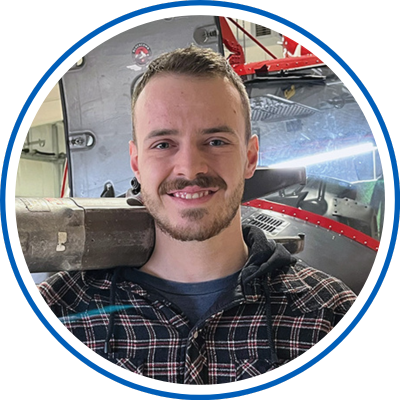
After graduating from SAIT last year, he snagged an apprenticeship at Chinook Aviation Inc., where he works on helicopters. As a structures technician, his job focuses on repairs and maintenance to the body of the aircraft, essentially “anything that holds the machine together,” he says. “We work on sheet metal and composite parts like fibreglass, carbon fibre or kevlar. I’ve also had the opportunity to learn how to paint helicopters.”
Working in a small shop like Chinook Aviation has allowed Matlo to try out a variety of jobs — an experience that gives him the chance to be highly creative. “Using your imagination is a huge part of making repairs,” he says. “Whatever you’re fixing usually has some set parameters, and sometimes, it can be pretty difficult to figure out how to make things work and make it look like the repaired area has always been there.”
Matlo credits his SAIT instructors for providing the space he needed to develop the creative and critical thinking skills he uses in his job every day. “My composite repair instructors were more than happy to help me experiment with different things,” he recalls. “They let me come up with solutions that were better than what was originally part of the assignment description.”
Matlo sees his current job as a gateway for both personal and career exploration. “I love learning new things,” he says. “The way I see it, the better I get at this, the more things I can do.” — KP
The future of flight
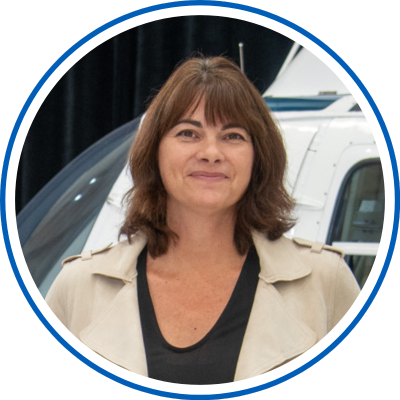
It’s already one of the largest aviation programs in Western Canada, but the demand for skilled professionals to maintain commercial, private and military aircraft is only increasing. And, Holden says, the massive technological advancements rapidly transforming aviation are “posing new opportunities for us to change how we teach and what we teach.”
For example, the recent addition of SAIT’s Professional Remotely Piloted Aircraft Systems diploma program — the first of its kind in Canada — positions the Aero Centre as a leader in advanced air mobility, unmanned flight and drones.
“As a pilot, Art Smith truly valued the importance of aircraft maintainers,” Holden says. His inspirational achievements continue to inspire and elevate the training centre named in his honour, preparing new generations for the vital, behind-the-scenes roles that make the future of flight possible.” — KP
link