


Theoretical foundations of research concept modeling and development
The theoretical foundation of the approach developed in this research is grounded in the Technology Acceptance Model (TAM). The TAM was proposed by Fred Davis in 198617 to explain the acceptance and use of technologies by users. This theory has found widespread application across various fields, including information and communication technology (ICT), marketing, and social sciences. The TAM comprises two components: perceived usefulness (PU), defined as the degree to which a user believes that a technology enhances their performance and facilitates their activities; and perceived ease of use (PEOU), referring to the extent to which a user believes that the technology is easy to use and straightforward to operate. The theory also accounts for external factors that may also influence how users accept and utilize technologies, including social norms, organizational characteristics, and individual factors that describe the users themselves18.
At the current stage of economic and business environment development, it is virtually impossible for companies to establish a competitive market position without the active implementation of digital technologies. Consequently, companies must engage in investment activities, including in the field of digital marketing tools and technologies,19 such as artificial intelligence (AI), big data analytics, cloud computing, and the Internet of Things (IoT). Another critical aspect is a company’s capacity for digital transformation and the adoption of digital marketing tools, which can be assessed through the perceived usefulness and ease of use of marketing technologies20. A company’s ability to finance and integrate new marketing technologies into its operations contributes to a key advantage—digital transformation. This process enhances operational efficiency, as digital systems enable more effective resource and supply chain management, driving productivity growth, cost reduction, and, consequently, improvements in financial sustainability and competitiveness. Moreover, digital transformation facilitates more effective managerial decision-making7.
In this study, the TAM was applied to understand how companies in developing economies perceive digital marketing technologies and how their perceptions influence the adoption of these technologies in business operations. It was hypothesized that if digital marketing tools were perceived by businesses as sufficiently easy to use and beneficial for their operations, there would be a higher likelihood of these technologies being practically implemented and integrated into company activities, thereby positively impacting performance7. In the process of digital transformation, businesses gradually incorporate digital technologies into various aspects of their operations, altering approaches to work and value creation for consumers21.
Previous studies suggest that SMEs typically adopt successful digital marketing strategies only after these strategies have proven effective for larger business entities6. However, the need to allocate financial and human resources poses a major barrier to implementation, while the effective adaptation of digital marketing practices to business-specific contexts remains challenging. These limitations create significant obstacles for businesses striving to achieve the maximum possible return from new marketing technologies22.
Moreover, in the contemporary dynamic environment, technologies, including digital marketing, evolve so rapidly that SMEs often struggle to keep pace with innovations and to implement them promptly upon availability23. Additionally, organizations may exhibit resistance to change, as the introduction of new technologies and digital transformation strategies entails alterations in established working methods24. Ultimately, it is anticipated that the final decision regarding the adoption of new digital technologies is influenced by several key predictors. These include business readiness (organizational preparedness based on established business infrastructure, financial capabilities, and management vision), perceived benefits of innovation (such as cost reductions, increased productivity, and sustainable competitiveness), market pressure from consumers and competitors, and alignment with the overall business strategy25.
Theoretical gap: hypotheses and research model
As one of the most common types of digital marketing, social media marketing can build a substantial user base with relatively low investment while also improving relationships with that audience26. Social media platforms are convenient for marketing activities because real or potential consumers spend a significant amount of time there, making them effective online venues for fostering deeper connections, enhancing retention, and increasing loyalty23. Online advertisements can be targeted based on consumers’ demographic characteristics, thereby ensuring higher conversion rates and better return on investment27. Search engine optimization enhances the visibility of a company and its products within search engines, leading to increased web traffic. Consequently, more frequent visits to the company’s website or social media pages drive higher sales28. Content marketing expands the brand’s presence in online environments. Specifically, this strategy attracts and retains the target audience, strengthening market positioning through valuable and engaging content, including articles, videos, infographics, and other materials29.
Thus, the following hypotheses can be proposed: (H1) The implementation of digital marketing tools positively influences a company’s capacity for digital transformation; and (H2) The implementation of digital marketing tools positively influences business performance.
Undoubtedly, virtually no modern business can survive in today’s business environment without utilizing digital technologies to at least some limited extent. This requirement necessitates investment in digital marketing tools and technologies (the IoT, cloud computing, artificial intelligence, and big data analytics) that increase business efficiency30. However, SMEs often lack in-house specialists, particularly those skilled in developing client applications, which raises concerns regarding the return on investment for such expenditures23. Overall, the impact of investments in technology depends on the digital adaptability of specific operational areas within a company31. Innovative approaches, such as artificial intelligence and client applications, enable businesses to minimize costs and maximize profits. To achieve the most significant effect, it is recommended to monitor in real time how implemented digital marketing technologies influence company revenue14.
Thus, the following hypotheses can be established: (H3) Investments in digital marketing technologies have a positive impact on business capacity for digital transformation; and (H4) Investments in digital marketing technologies have a positive impact on business performance.
An essential condition for the effective functioning of any business is the ability to attract consumers and retain customers. The application of digital marketing technologies facilitates the achievement of this objective through social media, official company pages, online advertisement platforms, mobile applications, and other channels. As a result, interaction with consumers becomes more effective, increasing the likelihood of repeat purchases32. It is unsurprising that engaged consumers are more likely to transition into loyal customers; therefore, companies strive to foster loyalty through mobile app messaging, high-quality content on social media platforms, and personalization33. For instance, the most effective strategies include the implementation of customizable email marketing programs with personalized advertisements, active communication with consumers on social media, and promotional campaigns with prompt feedback mechanisms34.
Based on the preceding discussion, the following hypotheses can be formulated: (H5) Increased consumer engagement positively impacts business capacity for digital transformation; and (H6) Increased consumer engagement positively influences business performance.
Business performance is a critical factor in growth and development, prompting companies to maximize profits, as operational efficiency is essential to sustaining productivity improvements35. The adoption of digital marketing innovations enhances a company’s market orientation, thereby increasing its ability to rapidly adapt to market changes, maintain competitiveness, boost productivity, and create new opportunities by establishing cost-effective communication channels with a broad consumer base. Digitalized companies have easier access to data on consumer preferences and greater capacity to analyze consumer reactions, enabling them to swiftly implement changes in products and services to better meet market demands36.
A distinct focus of this research involves assessing ethical risks associated with web analytics practices in online retail. These risks include the excessive collection of IP addresses, behavioral tracking without explicit consent, and insufficient transparency in personal data storage. Such practices may erode user trust and generate legal liabilities for businesses37.
Digital marketing strategies positively influence business performance by optimizing workflows and minimizing cost factors14. Consequently, the digital transformation of businesses increases consumer engagement and contributes to more effective information gathering and analysis, providing the necessary infrastructure for digital marketing strategies23. The integration of technologies such as big data analytics, AI, and the IoT into marketing models enhances business efficiency34. Companies that adopt and utilize digital tools can create product and service offerings that not only meet but also anticipate consumer desires38. This advantage results in higher returns on investment, improved productivity, and strengthened competitiveness14.
This discussion leads to the formulation of hypothesis H7: Business capacity for digital transformation positively impacts business performance.
Thus, the research model, grounded in the Technology Acceptance Model (TAM), posits that factors such as digital marketing tools, investments in digital marketing technologies, and increased consumer engagement enhance business performance through the growth of business capacity for digital transformation (Fig. 1).

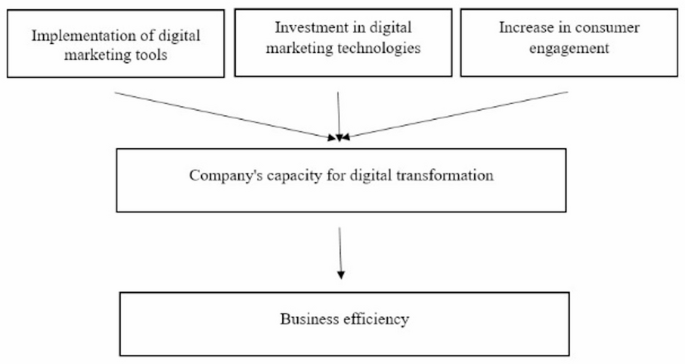
Research model. Compiled by the authors using available data14,23,24,26,30,31,33,34,36,37.
Given the above, this study aims to measure how these factors influence business capacity for digital transformation and ultimately business performance. The research objectives include (1) examining the theoretical foundations of digital marketing and its role in enhancing business performance, (2) exploring the features of digital marketing applications and their potential for attracting consumers, and (3) identifying the challenges associated with the acceptance and use of digital marketing technologies from the perspective of the Technology Acceptance Model (TAM).
In line with the proposed hypotheses, the study introduces several conceptual innovations that extend beyond the traditional application of the Technology Acceptance Model (TAM). Unlike classical approaches, the focus shifts from purely subjective perceptions of technology to tangible organizational actions—such as investments in digital marketing tools and enhancing consumer engagement. This research perspective broadens the practical applicability of the TAM by incorporating resource-based and operational determinants of digital transformation alongside behavioral predictors. Furthermore, the study proposes a mediator framework in which business capacity for digital transformation serves as the link between digital initiatives and ultimate business performance. This structure captures latent causal relationships that are difficult to identify through correlation analysis alone. The use of structural equation modeling (SEM) and discriminant validity testing strengthens the reliability of the findings. These analyses are particularly important in the context of developing economies, where superficial variable relationships may distort the true dynamics. A key theoretical contribution is the inclusion of consumer engagement as an independent construct within the model. Despite its evident role in the digital economy, this factor has rarely been examined as a mediator or predictor of digital transformation. Thus, this study expands the applicability of the TAM and adapts it to the unique conditions of rapidly evolving markets.
link