Michigan Tech Unveils Nature Megaphone on Tech Trails
Imagine being immersed in a cornucopia of quiet forest sounds — small animals rustling
in the underbrush, birds chirping softly, wind gently shifting the leaves. This is
what visitors to Michigan Technological University’s Tech Trails can experience inside
the recently installed nature megaphone.
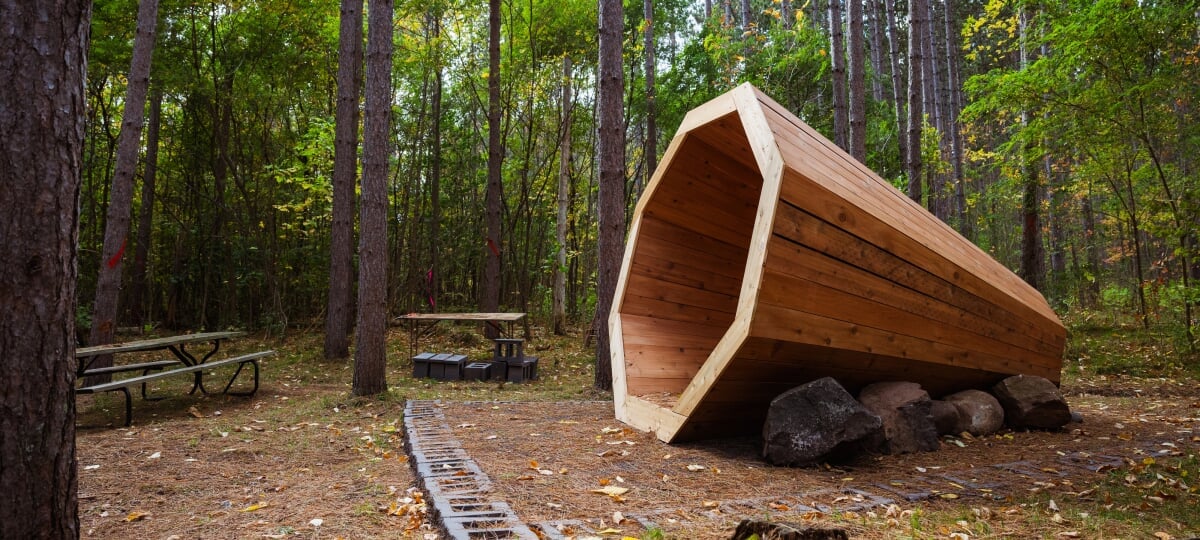
The 10-foot-long conical wooden structure, located at the intersection of the Tecumseh
and Sure Would trails near the Tech Trails main trailhead on Sharon Avenue, offers
a place of quiet contemplation that enhances the sounds of the natural world.
The megaphone, created by Lisa Gordillo and her students along with other campus partners, illustrates the kind of cross-campus
collaboration typical of Tech. Gordillo, an associate professor in Tech’s Department of Visual and Performing Arts (VPA) in the College of Sciences and Arts, is also the artist-in-residence in the University’s College of Forest Resources and Environmental Science (CFRES).
“A nature megaphone is an interactive sculpture for the forest,” said Gordillo. “It’s
an intersection of so many things: art, acoustic ecology, entertainment design, well-being,
community and sustainability. It allows people to experience nature in a different
way than they might expect.”
The megaphone’s design is based on the original nature megaphone created by designers Birgit Õigus, Tõnis Kalve and Ahti Grünberg, which is currently
installed at the Pähni Nature Center in Estonia. The Estonian installation has inspired
nature megaphones all over the world, including one recently installed at Belle Isle Park in Detroit. Tech’s nature megaphone team consulted on the project.
“Working with that team helped us clarify some of the work we were doing here,” said
Gordillo. “It also gave our students further opportunities to work with art and community.”
It Takes a Village to Build a Megaphone
The idea for a nature megaphone at Michigan Tech first took root when Michigan Tech
Board of Trustees member Jeff Littmann, CFRES Dean David Flaspohler and Joan Chadde, former director of Tech’s Center for Science and Educational Outreach, approached
Gordillo. They felt Gordillo’s history of creating art with a focus on bringing communities
together within their landscape aligned well with the megaphone’s purpose.
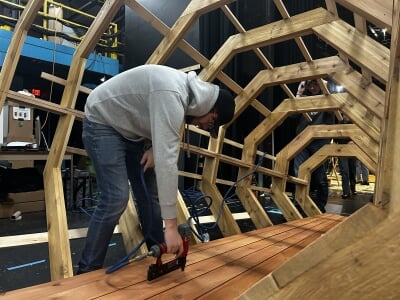
labor to design, construct and install Tech’s nature megaphone.
Gordillo saw the potential for the sculpture to address several needs, including the
human longing for community and connection.
Research shows that people tend to be healthier when they spend time outdoors, but
not everyone feels as if being in nature is accessible to them, said Gordillo. Another
benefit is to the outdoor space itself. “We know that our natural areas need us to
care for them more than ever,” she said.
Jared Anderson, VPA department chair, is among the many Huskies and community members who stepped
up to support the nature megaphone. Bringing the project to fruition required a massive,
interdisciplinary and collaborative effort — something Huskies are particularly suited
for.
“This kind of thing doesn’t happen just anywhere,” said Gordillo. “It takes a lot
of people working together, willing to share space, ideas and tools across disciplines.”
The Making of a Megaphone
Gordillo and her students spent a total of three years creating the megaphone. They
designed and created architectural models and prototypes ranging from two to five
feet long. The class tested various shapes and angles, experimenting with a solid
version and a prototype that could be disassembled and moved in two pieces. The megaphone
was constructed in the Rozsa Center for the Performing Arts scene shop with guidance from Kent Cyr, VPA associate professor, and scene shop supervisor Mat Moore. Each step of the process
introduced students to new perspectives and techniques.
“We had a lot of conversations about the differences between a scale drawing and a
hand-built object — sometimes subtle, sometimes larger,” said Gordillo. “We also talked
about the value of responding to an object as you build it — a more sculptural way
of thinking — letting it change and develop, even if those changes are different than
how it was planned on paper.”
During the next phase of development, Gordillo launched a course she’d created for
the project: Art, Ecology and Community. Students learned about public sculpture and
working sustainably with a community — and got to work building the full-size megaphone.
The course also encouraged students to see the project from all angles, exploring
meditative practices in the forest, gaining forest ecosystem knowledge from Tara Bal, associate professor of forest health, and learning about sounds disappearing from
the natural world from Chris Treviño, sound production manager at the Rozsa Center — all while sharpening their design
skills.
Creating and installing Tech’s nature megaphone required:
Three
Five
Two
1/4 ton
10
15+
42
125
60
600+
The course attracted students from all over Tech’s campus. For Paige McKean ’25, an
environmental engineering major, the nature megaphone was the perfect way to combine skill, creativity and
a love for the natural world.
“I really believe in preserving nature,” said McKean. “I think this will be a good
way for people to experience nature in a different way, and hopefully want to preserve
what they have in that space.”
Many students involved in the project had no previous experience with woodworking,
including 2025 grads Kat Davidson, a biomedical engineering major, and Annika Betz, who majored in applied ecology and environmental science.
“Within CFRES we learn a lot about how to manage forests so people can use these products.
Actually being able to use the products we’ve been taught to manage was very interesting.
I hadn’t really been on this side of that before,” said Betz.
Davidson enjoyed learning these practical skills. “There’s definitely a balance you
have to learn about where there is wiggle room for measurements and where there is
not. Sometimes it fixes itself when you’re cutting materials, other times you have
to go back and start a new drawing,” Davidson said.
For other Huskies, like Nikki Donley ’26, a theatre and entertainment technology major and one of the project’s lead carpenters, woodworking is old hat. However,
in a collaborative effort of this size, teamwork sometimes means taking a step back
— a lesson in contemplation that didn’t have to wait until the megaphone was finished.
“I’m a carpenter by profession,” said Donley. “I find myself slowing down and taking
my time so I don’t steamroll any of the other students.”
“The most interesting thing about the nature megaphone for me was being able to see
where these trees came from and what they could become, and then having that space
in the forest to go, sit, relax and know I helped create it.”
The final product is 10 feet long. It ranges from 18 inches wide at its narrowest
point to eight feet at the bell-shaped opening where visitors can enter the structure.
Built in two pieces, it was assembled on-site. The entire design and construction
process took at least 600 hours of labor from faculty, staff and 60 students.
An Amplified Community Effort
In addition to Littmann, Flaspohler, Chadde, Anderson, Cyr, Moore and Donley, Gordillo
credited numerous entities and individuals within Michigan Tech and the Keweenaw community
for their part in making the project a reality. She called out VPA Assistant Teaching
Professor Mike Maxwell; Brian Isaksson, Tech Trails operation coordinator; Donley’s fellow lead carpenter,
Cas Mankowski, a mechanical engineering graduate of 2022; and the Keweenaw Community Foundation for their contributions.
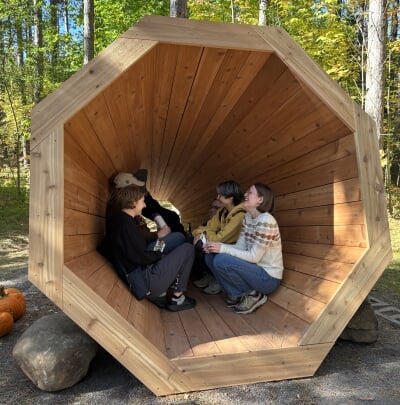
invited to experience its power to amplify sound and encourage human connection with
the world around us. (Photo: Lisa Gordillo)
Gordillo appreciates the widespread recognition of the value that the megaphone offers
the wider community.
“Often, these projects require more than what’s immediately visible within our own
resources,” said Gordillo. “People say yes because they really believe in the power
of art, and we figure these things out together.”
Gordillo and Littmann share a vision to place additional nature megaphones throughout
the Keweenaw. They see installing the first on the Tech Trails as a way to invite
the larger community to campus. The hope is that the connection to nature will also
highlight the benefits of a sustainable culture in which touchstones for quiet contemplation
can exist.
“We don’t always imagine all of the things art can really do in the world,” said Gordillo.
“It can engage with big problems, create spaces for communities to be together, and
envision completely new ways of addressing issues and concerns.”
For Donley, who was involved with the megaphone from the beginning, completing a project
of this magnitude comes with a quiet sense of rest and reflection — exactly what the
nature megaphone was designed for.
“There is a moment of gratitude. It was gratifying to be with it all the way through,”
she said.
Michigan Technological University is an R1 public research university founded in 1885 in Houghton, and is home to nearly 7,500 students from more than 60 countries around the world. Consistently ranked among the best universities in the country for return on investment, Michigan’s flagship technological university offers more than 185 undergraduate and graduate degree programs in science and technology, engineering, computing, forestry, business, health professions, humanities, mathematics, social sciences, and the arts. The rural campus is situated just miles from Lake Superior in Michigan’s Upper Peninsula, offering year-round opportunities for outdoor adventure.
link