Measuring digital transformation in high-end equipment manufacturing: an I-P-O model-based approach
Sample selection and data preprocessing
Currently, there is no unified definition of high-end equipment manufacturing enterprises in academia. In this study, we refer to the screening method used by Yan et al.31. and conducted an initial screening, resulting in 209 listed companies in the high-end equipment manufacturing sector that meet the required criteria. Companies with incomplete data, annual reports lacking relevant digital keywords, and those classified as ST and ST* were excluded, leaving a final sample of 124 companies. The data for this study were sourced from the CSMAR database, the Wind database, and the official websites of the listed companies. The introduction of”Made in China 2025″is used as a pivotal point, with 2015 marking the beginning of China’s fourth industrial revolution driven by digital technology. Given the difficulty in assessing the effects of digital transformation during that year and the availability of data, the sample period selected for analysis spans from 2016 to 2021.
During data collection, it was found that some R&D personnel compensation values were missing. This is because the Notice on Amending and Issuing the Format of Financial Statements of General Enterprises for 2018 explicitly required that, starting in 2018, R&D personnel compensation be disclosed separately in the notes to the financial statements. To address the missing values for 2016, this paper supplements the data by using the minimum value of the enterprise’s R&D personnel compensation from 2017 to 2021.
To avoid indicators reflecting redundant information, the correlation between indicators must be tested before calculating the weight, ensuring that relatively unimportant indicators with a correlation coefficient greater than 0.8 are eliminated. After calculating the Pearson correlation coefficient, it was found that the correlation between the indicators of digital strategy orientation and digital strategy orientation continuity was 0.909, indicating a strong correlation. As a result, the digital strategy orientation continuity indicator was eliminated, leaving a total of 18 effective evaluation indicators.
Evaluation result analysis
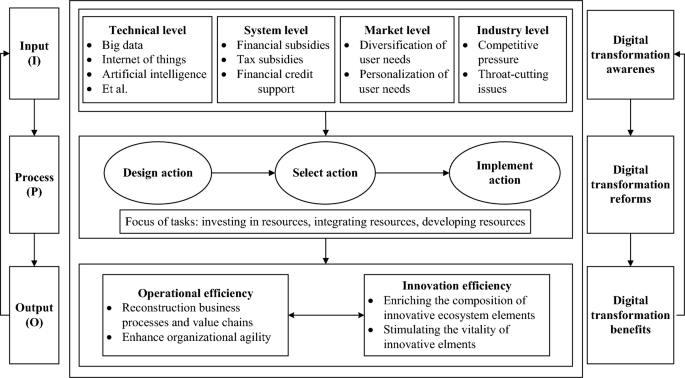
When using the VHSD-EM model to weight the indicators, a Spearman rank correlation test is required to verify the consistency of the model13. The specific test results are shown in Table 2. The results indicate that the measured outcomes of the VHSD and EM models are strongly positively correlated and significant at the 5% level, demonstrating good consistency in weight measurement between the two models, as well as the stability of the VHSD-EM model. On this basis, the comprehensive weights of each indicator were further calculated. Among these, the structure of the digital executive team, the amount of funds raised for digital projects, and the efficiency of digital invention patent output ranked highest, accounting for 17.48%, 11.70%, and 9.26%, respectively. This suggests that these three indicators are the primary factors currently influencing the level of digital transformation in high-end equipment manufacturing enterprises. Moreover, these three indicators correspond to the input, process, and output stages, respectively, which confirms the rationality of constructing an evaluation index system for the level of digital transformation from a”process perspective.”
Based on the determined indicator weights, the digital transformation scores of 124 enterprises from 2016 to 2021 were calculated, and the changes in their mean values are shown in Fig. 2. Overall, the digital transformation level of high-end equipment manufacturing enterprises shows an upward trend, albeit with a slow growth rate, increasing gradually from 0.1215 in 2016 to 0.1422 in 2021. However, the outbreak of the Sino-US trade war in 2018 significantly impacted the development of China’s ICT industry, making it difficult for the technology service sector to provide effective support for high-end equipment manufacturing enterprises, leading to a slight decline in digital transformation scores. In response, the Chinese government actively encouraged and guided high-end equipment manufacturing enterprises to pursue independent research and development of core technologies. In 2018, the Ministry of Industry and Information Technology issued the”13th Five-Year Plan for the Development of the High-End Equipment Manufacturing Industry.”Subsequently, various provinces and cities introduced relevant policies and measures to accelerate the digital transformation of China’s high-end equipment manufacturing enterprises. From 2019 onward, the digital transformation scores began to rise consistently, reaching a high of 0.1422 in 2021. Using 2016 as the base period, it was found that the digital transformation level of 79.84% of high-end equipment manufacturing enterprises improved significantly by 2021. However, only 24 enterprises experienced a growth rate exceeding 5%, indicating that relatively few enterprises achieved outstanding digital transformation. From 2016 to 2021, companies such as Zoomlion, Xuji Electric, and Aisino ranked among the top five in terms of digital transformation, as shown in Table 3. Notably, most of the top-ranking companies are state-controlled enterprises, which is attributed to their proactive response to policy initiatives promoting digital transformation and their ability to create exemplary transformation models. Several factors may explain this phenomenon. First, the nature of state-owned enterprises (SOEs) necessitates that they actively respond to policy directives and serve as models for digital transformation, making their transformation a national strategic priority. Second, SOEs benefit from substantial resource guarantees and possess extensive control over key industry data resources, which provide critical support for advancing digital transformation. Third, SOEs tend to exhibit greater strategic foresight and organizational coherence, allowing for comprehensive top-level design and long-term strategic planning. This enables them to better navigate the complexity and duration of digital transformation processes and enhances their capacity to absorb the risks associated with potential transformation failures. Additionally, state-controlled enterprises are more likely to access favorable conditions, such as bank credit, government subsidies, and tax incentives, providing them with more resources for digital transformation compared to private enterprises. At the guideline level, the score for digital transformation awareness increased the fastest, reflecting the shift of China’s high-end equipment manufacturing enterprises from passive acceptance to active exploration of digital transformation, driven by a complex ecosystem of technology, systems, markets, and industries. However, despite a relatively high score for digital transformation implementation, its growth rate remains slow. Furthermore, the score for the benefits of digital transformation has even declined in recent years. Possible reasons include the following: first, many companies fail to fully assess their actual circumstances and transformation needs, resulting in a blind pursuit of digital transformation and inefficient use of resources. Second, digital technologies are often not deeply integrated into core business operations, leading to suboptimal transformation outcomes. Third, insufficient attention to cultivating digital talent and building effective teams has caused a mismatch between employee skills and transformation requirements. Finally, delays in business process reengineering and management reforms have created a significant gap between digital investments and expected returns.

Score of the digital transformation level of high-end equipment manufacturing enterprises, 2016–2021.
Aviation equipment, satellites and applications, rail transit equipment, marine engineering equipment, and intelligent manufacturing equipment are high-end equipment manufacturing fields that China is focusing on developing. Here, the digital transformation level of high-end equipment manufacturing enterprises in the five key areas from 2016 to 2021 is further analyzed. As can be seen from Table 4, there are significant differences in the digital transformation level scores and the degree of change in the five key areas of high-end equipment manufacturing during the period under review.
Based on the digital transformation scores, the satellite and application equipment manufacturing industry consistently ranked first from 2016 to 2021, indicating its leading position in digital transformation among high-end equipment manufacturing sectors2. Except for the year 2017, the rail transportation equipment manufacturing industry consistently held second place, while the intelligent manufacturing equipment industry ranked third during the same period. Among the five key sectors of high-end equipment manufacturing, the aviation equipment and marine engineering equipment industries recorded the lowest digital transformation scores. From 2016 to 2020, the aviation equipment industry outperformed the marine engineering sector in digital transformation levels. However, in 2021, the marine engineering equipment industry experienced a significant improvement in its digital transformation score, surpassing the aviation sector and rising to fourth place. Consequently, by 2021, the aviation equipment manufacturing industry ranked lowest in digital transformation among the five major sectors.
In terms of growth in digital transformation scores, the satellite and application equipment manufacturing industry exhibited the highest increase, rising from 0.1590 in 2016 to 0.1958 in 2021—an increase of 23.14%, ranking first. This indicates that the industry not only maintains the highest level of digital transformation but also demonstrates the most rapid advancement. Although the marine engineering equipment manufacturing industry has a relatively lower overall score, it recorded the second-highest growth, increasing from 0.1073 in 2016 to 0.1299 in 2021—an increase of 21.06%. This rapid progress suggests that the industry is gradually narrowing the digital transformation gap with other high-end equipment manufacturing sectors. The rail transportation equipment and intelligent manufacturing equipment industries saw increases of 17.47% and 16.34%, respectively, ranking third and fourth in terms of growth. The aviation equipment manufacturing industry experienced the smallest increase, at only 13.54%. The disparity in growth rates across these five key sectors of high-end equipment manufacturing indicates a widening gap in their respective levels of digital transformation39.
Between 2016 and 2021, the level of digital transformation across the five key sectors of high-end equipment manufacturing improved to varying degrees. However, several challenges persist in advancing digital transformation. Specifically, although the satellite and application equipment manufacturing industry achieved significant progress, it continues to face limitations in enterprise management systems. These systems are often unable to implement integrated planning and execution across associated domains—such as unified management and application—thus hindering the formation of comprehensive operational capabilities. As a result, the sector struggles to meet the complex management demands of Chinese-style modernization40. To address this, the development of intelligent management systems supported by data and artificial intelligence is expected to become a key focus of the industry’s future digital transformation. The rail transportation and intelligent manufacturing equipment industries also face considerable challenges, including underdeveloped scenario-level digital platforms, a shortage of digital R&D talent, and weak collaboration within industrial clusters. These issues have contributed to a slowdown in their digital transformation progress. In particular, the intelligent manufacturing equipment industry is constrained by small enterprise size, limited technological R&D capacity, and relatively low resilience to external risks. For the aviation and marine engineering equipment industries, promoting digital transformation requires building integrated development environments for product design, manufacturing, and service based on industrial internet platforms. Such environments should enable co-development, process optimization, and improved operations and maintenance, which are critical to addressing the core issues impeding digital transformation in these sectors41.
link